A new book from Michael J. Mauboussin

The Investing Mind

A guide to the principles and processes of successful investing. Renowned investment strategist Michael J. Mauboussin reveals the ten most important attributes of successful investors.

Hardcover · Harriman House · Pre-order price guarantee

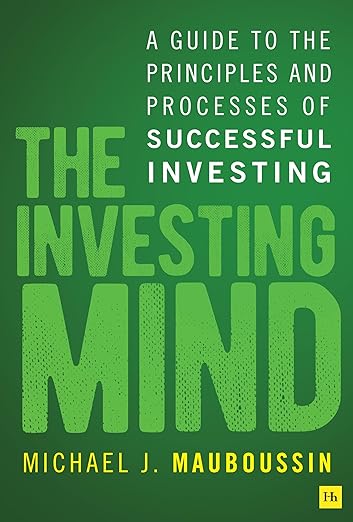
The Investing Mind book cover

About the book

Not what to think.
How to think well.

Michael Mauboussin has spent 40 years on Wall Street and more than three decades teaching investment analysis at Columbia Business School. In that time, he has met, worked with, taught and studied many great investors.

Now, for the first time, he brings that wealth of experience together and answers the question: what are the qualities that lead to success in financial markets? As Mauboussin shows, this is not about what investors should think. It is about how investors can think well.

In The Investing Mind, Mauboussin discusses the importance of practical abilities such as numeracy, capital allocation and balancing risk versus reward, as well as behavioral qualities including assessing strategy, understanding your own bias, and maintaining an open mind.

In an increasingly competitive investment landscape, The Investing Mind provides actionable insights for investors. It is a must-read for anyone who makes decisions under conditions of uncertainty, including investors everywhere.
You’ll learn

01

Think probabilistically

How and why investors need to think probabilistically when the future refuses to sit still.

02

Always ask, “Compared to what?”

Every judgment of value, skill, or performance only means something against the right benchmark.

03

Play to your strengths

How to play to your strengths and avoid playing the wrong games.

04

And much, much more

Actionable insights for anyone who makes decisions under conditions of uncertainty.

From the book

The Snowball Effect

“Life is like a snowball. The important thing is finding wet snow and a really long hill.”

Warren Buffett

Pack a snowball, pick your snow and your hill, and let it roll. It grows slowly at first. Then all at once.

diameter
20 cm
how well it packs
40%
fresh powder
4 cm
grade
20°
the long hill
140 m
If it keeps rolling Ø 1.21 m · 315 kg

Pack the snow, set the hill, and let it roll.

About the author

Michael J.
Mauboussin

Michael J. Mauboussin is one of the most respected voices in investing, a strategist known for bridging the worlds of finance, psychology, and complex systems.

He has spent 40 years on Wall Street and has taught investment analysis at Columbia Business School for more than three decades, where generations of investors have passed through his security analysis course. He is Head of Consilient Research at Counterpoint Global, Morgan Stanley Investment Management.

His previous books include Expectations Investing (with Alfred Rappaport), More Than You Know, Think Twice, and The Success Equation. These works have shaped how a generation of professionals think about skill, luck, and markets.

The research behind the book

Bibliography

The complete bibliography of The Investing Mind — 606 works cited in the book.

  1. Abelson, Robert P., “Beliefs Are Like Possessions,” Journal for the Theory of Social Behaviour, Vol. 16, No. 3, October 1986, 223–250.
  2. Adame, Katharine W., Jennifer L. Koski, Katie W. Lem, and Sarah E. McVay, “Free Cash Flow Disclosure in Earnings Announcements,” Journal of Financial Reporting, Vol. 8, No. 2, Fall 2023, 1–23.
  3. Adler, Mortimer J., and Charles Van Doren, How to Read a Book: The Classic Guide to Intelligent Reading—Revised and Updated Edition (New York: Touchstone, 1972).
  4. Akbar, Saeed, Syed Zulfiqar Ali Shah, and Issedeeq Saadi, “Stock Market Reaction to Capital Expenditure Announcements by UK Firms,” Applied Financial Economics, Vol. 18, No. 8, 2008, 617–627.
  5. Allen, Joseph A., and Nale Lehmann-Willenbrock, “The Key Features of Workplace Meetings: Conceptualizing the Why, How, and What of Meetings at Work,” Organizational Psychology Review, Vol. 13, No. 4, November 2023, 355–378.
  6. Alloy, Lauren B., and Lyn Y. Abramson, “Judgment of Contingency in Depressed and Nondepressed Students: Sadder but Wiser?” Journal of Experimental Psychology: General, Vol. 108, No. 4, December 1979, 441–485.
  7. Almeida, Heitor, “Is It Time to Get Rid of Earnings-per-Share (EPS)?” Review of Corporate Finance Studies, Vol. 8, No. 1, March 2019, 174–206.
  8. Altshuller, Stan, “The Skill of Prediction: Hedge Fund Position Sizing,” SEI Novus, May 25, 2016.
  9. Andersen, Hans Christian, Jean Hersholt, Translator, and Fritz Kredel, Illustrator, Andersen’s Fairy Tales (New York: Heritage Press, 1942).
  10. Andonov, Aleksandar, and Joshua D. Rauh, “The Return Expectations of Institutional Investors,” Stanford University Graduate School of Business Research Paper No. 18-5, November 19, 2018.
  11. Armstrong, Robert, and Ethan Wu, “Uber’s Dara Khosrowshahi Defends Buyback Policy,” Financial Times, February 28, 2024.
  12. Arnold, Allen G., R. Barry Ellis, and V. Sivarama Krishnan, “Toward Effective Use of the Statement of Cash Flows,” Journal of Business and Behavioral Sciences, Vol. 30, No. 2, Fall 2018, 46–62.
  13. Arnott, Rob, Vitali Kalesnik, and Lillian Wu, “The Folly of Hiring Winners and Firing Losers,” Journal of Portfolio Management, Vol. 45, No. 1, Fall 2018, 71–84.
  14. Arrow, Kenneth J., Social Choice and Individual Values (New York: John Wiley & Sons, 1951).
  15. Asch, S. E., “Effects of Group Pressure Upon the Modification and Distortion of Judgments,” in Harold Guetzkow, ed., Groups, Leadership and Men: Research in Human Relations (Pittsburgh, PA: Carnegie Press, 1951), 177–190.
  16. Asch, Solomon E., “Opinions and Social Pressure,” Scientific American, Vol. 193, No. 5, November 1955, 31–35.
  17. Asness, Clifford S., Tobias J. Moskowitz, and Lasse Heje Pedersen, “Value and Momentum Everywhere,” Journal of Finance, Vol. 68, No. 3, June 2013, 929–985.
  18. Attia, Peter, and Bill Gifford, Outlive: The Science and Art of Longevity (New York: Harmony, 2023).
  19. Aubé, Caroline, Vincent Rousseau, and Sébastien Tremblay, “Team Size and Quality of Group Experience: The More the Merrier?” Group Dynamics: Theory, Research, and Practice, Vol. 15, No. 4, December 2011, 357–375.
  20. Ayyagari, Meghana, Asli Demirgüç-Kunt, and Vojislav Maksimovic, “The Rise of Star Firms: Intangible Capital and Competition,” The Review of Financial Studies, Vol. 37, No. 3, March 2024, 882–949.
  21. Baer, Drake, “Nine Books Billionaire Warren Buffett Thinks Everyone Should Read,” Business Insider, September 2, 2014.
  22. Baker, Malcolm, and Jeffrey Wurgler, “Investor Sentiment and the Cross-Section of Stock Returns,” Journal of Finance, Vol. 61, No. 4, August 2006, 1645–1680.
  23. ———., “Investor Sentiment in the Stock Market,” Journal of Economic Perspectives, Vol. 21, No. 2, Spring 2007, 129–151.
  24. Baker, Malcolm, Stefan Nagel, and Jeffrey Wurgler, “The Effect of Dividends on Consumption,” Brookings Papers on Economic Activity, No. 1, 2007, 231–276.
  25. Baker, Scott, Nicholas Bloom, Steven Davis, and Marco Sammon, “The Distinctive Character of Policy-Driven Stock Market Jumps,” Becker Friedman Institute White Paper, May 24, 2021.
  26. Baldwin, Carliss Y., and Kim B. Clark, Design Rules, Volume 1: The Power of Modularity (Cambridge, MA: MIT Press, 2000).
  27. Ball, Ray, Joseph Gerakos, Juhani T. Linnainmaa, and Valeri Nikolaev, “Accruals, Cash Flows, and Operating Profitability in the Cross Section of Stock Returns,” Journal of Financial Economics, Vol. 121, No. 1, July 2016, 28–45.
  28. Banerji, Gunjan, “Wall Street’s Hot New Trade Is Fueling Gambling Addictions,” The Wall Street Journal, December 23, 2024.
  29. Barahona, Ricardo, Stefano Cassella, and Kristy A. E. Jansen, “Do Teams Alleviate or Exacerbate Cognitive Biases: Evidence from Extrapolation Bias in Mutual Funds,” Working Paper, October 19, 2022.
  30. Barber, Brad M., and Terrance Odean, “Boys Will Be Boys: Gender, Overconfidence, and Common Stock Investment,” Quarterly Journal of Economics, Vol. 116, No. 1, February 2001, 261–292.
  31. ———., “The Behavior of Individual Investors,” in George Constantinides, Milton Harris, and Rene M. Stulz, eds., Handbook of the Economics of Finance, Vol. 2, Part B, Chapter 22 (Amsterdam: Elsevier, 2013), 1533–1570.
  32. Barber, Brad M., Yi-Tsung Lee, Yu-Jane Liu, and Terrance Odean, “Just How Much Do Individual Investors Lose by Trading?” The Review of Financial Studies, Vol. 22, No. 2, February 2009, 609–632.
  33. Barber, Brad M., Yi-Tsung Lee, Yu-Jane Liu, Terrance Odean, and Ke Zhang, “Learning, Fast or Slow,” The Review of Asset Pricing Studies, Vol. 10, No. 1, February 2020, 61–93.
  34. Barber, Brad M., Xing Huang, Terrance Odean, and Christopher Schwartz, “Attention‐Induced Trading and Returns: Evidence from Robinhood Users,” Journal of Finance, Vol. 77, No. 6, December 2022, 3141–3190.
  35. Barberis, Nicholas, and Richard H. Thaler, “A Survey of Behavioral Finance,” in George Constantinides, Milton Harris, and René M. Stulz, eds., Handbook of the Economics of Finance, Vol. 1, Part B, Chapter 18 (Amsterdam: Elsevier, 2003), 1053–1128.
  36. Barberis, Nicholas, “Psychology-Based Models of Asset Prices and Trading Volume,” in B. Douglas Bernheim, Stefano DellaVigna, and David Laibson, eds., Handbook of Behavioral Economics: Foundations and Applications 1 (Amsterdam: North-Holland, 2018), 79–175.
  37. Barnea, Amir, Henrik Cronqvist, and Stephan Siegel, “Nature or Nurture: What Determines Investor Behavior?” Journal of Financial Economics, Vol. 98, No. 3, December 2010, 583–604.
  38. Baron, Jonathan, and John C. Hershey, “Outcome Bias in Decision Evaluation,” Journal of Personality and Social Psychology, Vol. 54, No. 4, April 1988, 569–579.
  39. Baron-Cohen, Simon, Sally Wheelwright, and Therese Jolliffe, “Is There a ‘Language of the Eyes’? Evidence from Normal Adults, and Adults with Autism or Asperger Syndrome,” Visual Cognition, Vol. 4, No. 3, 1997, 311–331.
  40. Bastianello, Francesca, and Paul Fontanier, “Expectations and Learning from Prices,” The Review of Economic Studies, Vol. 92, No. 3, May 2025, 1341–1374.
  41. Bazerman, Max H., Judgment in Managerial Decision Making, Fourth Edition (New York: John Wiley & Sons, 1998).
  42. Becker, Gary S., “Irrational Behavior and Economic Theory,” Journal of Political Economy, Vol. 70, No. 1, February 1962, 1–13.
  43. Benartzi, Shlomo, and Richard H. Thaler, “Myopic Loss Aversion and the Equity Premium Puzzle,” The Quarterly Journal of Economics, Vol. 110, No. 1, February 1995, 73–92.
  44. Ben-David, Itzhak, Francesco Franzoni, Byungwook Kim, and Rabih Moussawi, “Competition for Attention in the ETF Space,” The Review of Financial Studies, Vol. 36, No. 3, March 2023, 987–1042.
  45. Ben-David, Itzhak, and Alexander M. Chinco, “Modeling Managers as EPS Maximizers,” NBER Working Paper 31125, April 2023.
  46. Benjamin, Daniel J., Sebastian A. Brown, and Jesse M. Shapiro, “Who is ‘Behavioral’? Cognitive Ability and Anomalous Preferences,” Journal of the European Economic Association, Vol. 11, No. 6, December 2013, 1231–1255.
  47. Bentley, Jeremiah W., Theodore E. Christensen, Kurt H. Gee, and Benjamin C. Whipple, “Disentangling Managers’ and Analysts’ Non-GAAP Reporting,” Journal of Accounting Research, Vol. 56, No. 4, September 2018, 1039–1081.
  48. Berk, Jonathan B., and Jules H. van Binsbergen, “Measuring Skill in the Mutual Fund Industry,” Journal of Financial Economics, Vol. 118, No. 1, October 2015, 1–20.
  49. Berns, Gregory, Iconoclast: A Neuroscientist Reveals How to Think Differently (Boston, MA: Harvard Business Press, 2008).
  50. Berns, Gregory S., Jonathan Chappelow, Caroline F. Zink, Giuseppe Pagnoni, Megan Martin-Skurski, and Jim Richards, “Neurobiological Correlates of Social Conformity and Independence During Mental Rotation,” Biological Psychiatry, Vol. 58, No. 3, August 2005, 245–253.
  51. Bernstein, Peter L., “Risk, Time, and Reversibility,” The Geneva Papers on Risk and Insurance, Vol. 24, No. 2, April 1999, 131–139.
  52. Bessembinder, Hendrik, “Do Stocks Outperform Treasury Bills?” Journal of Financial Economics, Vol. 129, No. 3, September 2018, 440–457.
  53. ———., “Wealth Creation in the US Public Stock Markets 1926–2019,” Journal of Investing, Vol. 30, No. 3, April 2021, 47–61.
  54. ———., “Which U.S. Stocks Generated the Highest Long-Term Returns?” SSRN Working Paper 4897069, November 11, 2024.
  55. ———., “One Hundred Years in the U.S. Stock Markets,” Working Paper, March 2026.
  56. Bessembinder, Hendrik, Michael J. Cooper, and Feng Zhang, “Mutual Fund Performance at Long Horizons,” Journal of Financial Economics, Vol. 147, No. 1, January 2023, 132–158.
  57. Bessembinder, Hendrik, Te-Feng Chen, Goeun Choi, and K. C. John Wei, “Long-Term Shareholder Returns: Evidence from 64,000 Global Stocks,” Financial Analysts Journal, Vol. 79, No. 3, Third Quarter 2023, 33–63.
  58. Beyer, Andrew, Picking Winners: A Horseplayer’s Guide (Boston, MA: Houghton Mifflin Company, 1994).
  59. Bezos, Jeff, “2020 Letter to Shareholders,” Amazon Annual Report, 2020.
  60. Bharath, Sreedhar T., and Amy K. Dittmar, “Why Do Firms Use Private Equity to Opt Out of Public Markets?” The Review of Financial Studies, Vol. 23, No. 5, May 2010, 1771–1818.
  61. Bhattacharya, Nilabhra, Ervin L. Black, Theodore E. Christensen, and Chad R. Larson, “Assessing the Relative Informativeness and Permanence of Pro Forma Earnings and GAAP Operating Earnings,” Journal of Accounting and Economics, Vol. 36, Nos. 1–3, December 2003, 285–319.
  62. Bhojraj, Sanjeev, “Stock Compensation Expense, Cash Flows, and Inflated Valuations,” Review of Accounting Studies, Vol. 25, No. 3, September 2020, 1078–1097.
  63. Biggs, Barton, Hedgehogging (Hoboken, NJ: John Wiley & Sons, 2006).
  64. Bikhchandani, Sushil, David Hirshleifer, and Ivo Welch, “A Theory of Fads, Fashion, Custom, and Cultural Change as Informational Cascades,” Journal of Political Economy, Vol. 100, No. 5, October 1992, 992–1026.
  65. Black, Dirk E., Theodore E. Christensen, Jack T. Ciesielski, and Benjamin C. Whipple, “Non-GAAP Reporting: Evidence from Academia and Current Practice,” Journal of Business Finance & Accounting, Vol. 45, Nos. 3–4, March/April 2018, 259–294.
  66. ———., “Non-GAAP Earnings: A Consistency and Comparability Crisis?” Contemporary Accounting Research, Vol. 38, No. 3, Fall 2021, 1712–1747.
  67. Blenko, Marcia, Michael C. Mankins, and Paul Rogers, Decide and Deliver: Five Steps to Breakthrough Performance in Your Organization (Boston, MA: Harvard Business Review Press, 2010).
  68. Bloom, Nicholas, Charles I. Jones, John Van Reenen, and Michael Webb, “Are Ideas Getting Harder to Find?” American Economic Review, Vol. 110, No. 4, April 2020, 1104–1144.
  69. Bloomberg, Lawrence N., The Investment Value of Goodwill (Baltimore, MD: The Johns Hopkins Press, 1938).
  70. Blose, Laurence E., and Joseph C. P. Shieh, “Tobin’s q-Ratio and Market Reaction to Capital Investment Announcements,” Financial Review, Vol. 32, No. 3, August 1997, 449–476.
  71. Bogle, John, “The Arithmetic of ‘All-In’ Investment Expenses,” Financial Analysts Journal, Vol. 70, No. 1, January/February 2014, 13–21.
  72. Bonaimé, Alice A., and Kathleen M. Kahle, “Share Repurchases,” in David J. Denis, ed., Handbook of Corporate Finance (Cheltenham, UK: Edward Elgar Publishing Limited, 2024), 176–222.
  73. Bordalo, Pedro, Nicola Gennaioli, Rafael La Porta, and Andrei Shleifer, “Diagnostic Expectations and Stock Returns,” Journal of Finance, Vol. 74, No. 6, December 2019, 2839–2874.
  74. Bouchaud, Jean-Philippe, “The Endogenous Dynamics of Markets: Price Impact and Feedback Loops,” ArXiv:1009.2928, September 15, 2010.
  75. Brandenburger, Adam M., and Harborne W. Stuart, Jr., “Value-Based Business Strategy,” Journal of Economics & Management Strategy, Vol. 5, No. 1, Spring 1996, 5–24.
  76. Bräuer, Konstantin, Andreas Hackethal, and Tobin Hanspal, “Consuming Dividends,” The Review of Financial Studies, Vol. 35, No. 10, October 2022, 4802–4857.
  77. Brav, Alon, John R. Graham, Campbell R. Harvey, and Roni Michaely, “Payout Policy in the 21st Century,” Journal of Financial Economics, Vol. 77, No. 3, September 2005, 483–527.
  78. Brier, Glenn W., “Verification of Forecasts Expressed in Terms of Probability,” Monthly Weather Review, Vol. 78, No. 1, January 1950, 1–3.
  79. Bromiley, Philip, Corporate Capital Investment: A Behavioral Approach (Cambridge, UK: Cambridge University Press, 1986).
  80. Brown, Alexander L., Taisuke Imai, Ferdinand M. Vieider, and Colin F. Camerer, “Meta-Analysis of Empirical Estimates of Loss Aversion,” Journal of Economic Literature, Vol. 62, No. 2, June 2024, 485–516.
  81. Bruine de Bruin, Wändi, Andrew M. Parker, and Baruch Fischhoff, “Decision-Making Competence: More Than Intelligence?” Current Directions in Psychological Science, Vol. 29, No. 2, April 2020, 186–192.
  82. Brynjolfsson, Erik, and Lorin M. Hitt, “Beyond Computation: Information Technology, Organizational Transformation and Business Performance,” Journal of Economic Perspectives, Vol. 14, No. 4, Fall 2000, 23–48.
  83. Brynjolfsson, Erik, Danielle Li, and Lindsey R. Raymond, “Generative AI at Work,” The Quarterly Journal of Economics, Vol. 140, No. 2, May 2025, 889–942.
  84. Buffett, Warren E., foreword to Benjamin Graham and David L. Dodd, Security Analysis, Sixth Edition (New York: McGraw Hill, 2009).
  85. ———., Terry Leadership Speaker Series, 2001.
  86. ———., “Interview of Warren Buffett,” United States of America Financial Crisis Inquiry Commission, May 26, 2010.
  87. ———., Berkshire Hathaway Annual Meeting, 1989.
  88. ———., “Letter to Shareholders,” Berkshire Hathaway Annual Report, 1987.
  89. ———., “Letter to Shareholders,” Berkshire Hathaway Annual Report, 1989.
  90. ———., “Letter to Shareholders,” Berkshire Hathaway Annual Report, 1996.
  91. ———., “Letter to Shareholders,” Berkshire Hathaway Annual Report, 2001.
  92. ———., “Letter to Shareholders,” Berkshire Hathaway Annual Report, 2022.
  93. Busenbark, John R., Robert M. Wiseman, Mathias Arrfelt, and Hyun-Soo Woo, “A Review of the Internal Capital Allocation Literature: Piecing Together the Capital Allocation Puzzle,” Journal of Management, Vol. 43, No. 8, November 2017, 2430–2455.
  94. Cain, Susan, Quiet: The Power of Introverts in a World That Can’t Stop Talking (New York: Crown Publishers, 2012).
  95. Camerer, Colin F., “Do Biases in Probability Judgment Matter in Markets? Experimental Evidence,” American Economic Review, Vol. 77, No. 5, December 1987, 981–997.
  96. Campbell, John L., Kurt H. Gee, and Zac Wiebe, “The Determinants and Informativeness of Non-GAAP Revenue Disclosures,” The Accounting Review, Vol. 97, No. 7, November 2022, 23–48.
  97. Campbell, Sandy, and Don A. Moore, “Overprecision in the Survey of Professional Forecasters,” Collabra: Psychology, Vol. 10, No. 1, 2024, 92953.
  98. Carlile, Paul R., and Clayton M. Christensen, “The Cycles of Theory Building in Management Research,” Harvard Business School Working Paper 05-057, February 2005.
  99. Cassar, Lea, and Stephan Meier, “Nonmonetary Incentives and the Implications of Work as a Source of Meaning,” Journal of Economic Perspectives, Vol. 32, No. 3, Summer 2018, 215–238.
  100. Caves, R. E., and M. E. Porter, “Market Structure, Oligopoly, and Stability of Market Shares,” Journal of Industrial Economics, Vol. 26, No. 4, June 1978, 289–313.
  101. Cen, Ling, Michael G. Hertzel, and Christoph Schiller, “Speed Matters: Limited Attention and Supply-Chain Information Diffusion,” Management Science, Vol. 71, No. 10, October 2025, 8642–8669.
  102. Cesarini, David, Magnus Johannesson, Paul Lichtenstein, Örjan Sandewall, and Björn Wallace, “Genetic Variation in Financial Decision-Making,” Journal of Finance, Vol. 65, No. 5, October 2010, 1725–1754.
  103. Chamberlin, Edward H., “An Experimental Imperfect Market,” Journal of Political Economy, Vol. 56, No. 2, April 1948, 95–108.
  104. Chamorro-Premuzic, Tomas, “Does Money Really Affect Motivation? A Review of the Research,” Harvard Business Review, April 10, 2013.
  105. Chancellor, Edward, The Price of Time: The Real Story of Interest (New York: Atlantic Monthly Press, 2022).
  106. Chang, Welton, Eva Chen, Barbara Mellers, and Philip Tetlock, “Developing Expert Political Judgment: The Impact of Training and Practice on Judgmental Accuracy in Geopolitical Forecasting Tournaments,” Judgment and Decision Making, Vol. 11, No. 5, September 2016, 509–526.
  107. Chaudhry, Aditya, “The Impact of Prices on Analyst Cash Flow Expectations: Reconciling Subjective Beliefs Data with Rational Discount Rate Variation,” Journal of Financial Economics, Vol. 171, September 2025, 104095.
  108. Chellel, Kit, “The Gambler Who Cracked the Horse-Racing Code,” Businessweek, May 3, 2018.
  109. Chen, Alvin, and Olga A. Obizhaeva, Stock Buyback Motivations and Consequences: A Literature Review (Charlottesville, VA: CFA Institute Research Foundation, 2022).
  110. Chen, Jason V., Kurt H. Gee, and Jed J. Neilson, “Disclosure Prominence and the Quality of Non-GAAP Earnings,” Journal of Accounting Research, Vol. 59, No. 1, March 2021, 163–213.
  111. Chen, M. Keith, Venkat Lakshminarayanan, and Laurie R. Santos, “How Basic Are Behavioral Biases? Evidence from Capuchin Monkey Trading Behavior,” Journal of Political Economy, Vol. 114, No. 3, June 2006, 517–537.
  112. Chen, Joseph, Samuel Hanson, Harrison Hong, and Jeremy C. Stein, “Do Hedge Funds Profit from Mutual-Fund Distress?” NBER Working Paper 13786, February 2008.
  113. Chevalier, Judith, and Glenn Ellison, “Are Some Mutual Fund Managers Better Than Others? Cross-Sectional Patterns in Behavior and Performance,” Journal of Finance, Vol. 54, No. 3, June 1999, 875–899.
  114. Chi, Michelene T. H., Robert Glaser, and Marshall Farr, eds., The Nature of Expertise (Hillsdale, NJ: Lawrence Erlbaum Associates, 1988).
  115. Chincarini, Ludwig, Renato Lazo-Paz, and Fabio Moneta, “Crowded Spaces and Anomalies,” Working Paper, February 28, 2025.
  116. Christensen, Clayton M., The Innovator’s Dilemma: When New Technologies Cause Great Firms to Fail (Boston, MA: Harvard Business School Press, 1997).
  117. Christensen, Clayton M., Matt Verlinden, and George Westerman, “Disruption, Disintegration, and the Dissipation of Differentiability,” Industrial and Corporate Change, Vol. 11, No. 5, November 2002, 955–993.
  118. Chu, Li, Jeanne L. Tsai, and Helene H. Fung, “Association Between Age and Intellectual Curiosity: The Mediating Roles of Future Time Perspective and Importance of Curiosity,” European Journal of Ageing, Vol. 18, No. 1, March 2021, 45–53.
  119. Chung, Kee H., Peter Wright, and Charlie Charoenwong, “Investment Opportunities and Market Reaction to Capital Expenditure Decisions,” Journal of Banking & Finance, Vol. 22, No. 1, January 1998, 41–60.
  120. Cialdini, Robert B., and Melanie R. Trost, “Social Influence: Social Norms, Conformity, and Compliance,” in Daniel T. Gilbert, Susan T. Fiske, and Gardner Lindzey, eds., The Handbook of Social Psychology 4th Edition, Vol. 2 (New York: McGraw Hill, 1998), 151–192.
  121. Cici, Gjergji, Mario Hendriock, and Alexander Kempf, “Finding Your Calling: Matching Skills with Jobs in the Mutual Fund Industry,” Management Science, Vol. 71, No. 12, December 2025, 9936–9954.
  122. Clarke, Roger, Harindra de Silva, and Steven Thorley, “The Fundamental Law of Active Portfolio Management,” Journal of Investment Management, Vol. 4, No. 3, Third Quarter 2006, 54–72.
  123. Cochrane, John, “Discount Rates,” Journal of Finance, Vol. 66, No. 4, August 2011, 1047–1108.
  124. Cohen, Lauren, and Andrea Frazzini, “Economic Links and Predictable Returns,” Journal of Finance, Vol. 63, No. 4, August 2008, 1977–2011.
  125. Cohen, Lauren, Christopher J. Malloy, Quoc Nguyen, “Lazy Prices,” Journal of Finance, Vol. 75, No. 3, June 2020, 1371–1415.
  126. Cohen, Randolph B., Paul A. Gompers, and Tuomo Vuolteenaho, “Who Underreacts to Cash-Flow News? Evidence from Trading between Individuals and Institutions,” Journal of Financial Economics, Vol. 66, Nos. 2–3, November-December 2002, 409–462.
  127. Cooper, Arnold C., Carolyn Y. Woo, and William C. Dunkelberg, “Entrepreneurs’ Perceived Chances for Success,” Journal of Business Venturing, Vol. 3, No. 2, Spring 1988, 97–108.
  128. Cootner, Paul H., ed., The Random Character of Stock Market Prices (Cambridge, MA: MIT Press, 1964).
  129. Cornell, Bradford, “What Moves Stock Prices: Another Look,” Journal of Portfolio Management, Vol. 39, No. 3, Spring 2013, 32–38.
  130. Cornell, Bradford, Jason Hsu, and David Nanigian, “Does Past Performance Matter in Investment Manager Selection?” Journal of Portfolio Management, Vol. 48, No. 5, April 2022, 33–43.
  131. Cosier, Richard A., “The Effects of Three Potential Aids for Making Strategic Decisions on Prediction Accuracy,” Organizational Behavior and Human Performance, Vol. 22, No. 2, October 1978, 295–306.
  132. Coval, Joshua, and Erik Stafford, “Asset Fire Sales (and Purchases) in Equity Markets,” Journal of Financial Economics, Vol. 86, No. 2, November 2007, 479–512.
  133. Crane, Alan, Kevin Crotty, and Tarik Umar, “Hedge Funds and Public Information Acquisition,” Management Science, Vol. 69, No. 6, June 2023, 3241–3262.
  134. Crist, Steven, “Crist on Value,” in Victor Mather, ed., Bet With the Best: All New Strategies from America’s Leading Handicappers (New York: Daily Racing Form, 2001), 61–74.
  135. ———., Betting on Myself: Adventures of a Horseplayer and Publisher (New York: DRF Press, 2003).
  136. ———., Exotic Betting: How to Make the Multihorse, Multirace Bets That Win Racing’s Biggest Payoffs (New York: DRF Press, 2006).
  137. Curtis, Asher B., Sarah E. McVay, and Benjamin C. Whipple, “The Disclosure of Non-GAAP Earnings Information in the Presence of Transitory Gains,” The Accounting Review, Vol. 89, No. 3, May 2014, 933–958.
  138. Curtis, Asher, Sarah McVay, and Sara Toynbee, “The Changing Implications of Research and Development Expenditures for Future Profitability,” Review of Accounting Studies, Vol. 25, No. 2, June 2020, 405–437.
  139. Cutler, David M., and Lawrence H. Summers, “The COVID-19 Pandemic and the $16 Trillion Virus,” JAMA, Vol. 324, No. 15, October 20, 2020, 1495–1496.
  140. Cutler, David M., James M. Poterba, and Lawrence H. Summers, “What Moves Stock Prices?” Journal of Portfolio Management, Vol. 15, No. 3, Spring 1989, 4–12.
  141. Damodaran, Aswath, Narrative and Numbers: The Value of Stories in Business (New York: Columbia Business School Publishing, 2017).
  142. ———., “A Viral Market Meltdown III: Pricing or Value? Trading or Investing?” Musings on Markets, March 16, 2020.
  143. Dane, Erik, Kevin W. Rockmann, and Michael G. Pratt, “When Should I Trust My Gut? Linking Domain Expertise to Intuitive Decision-Making Effectiveness,” Organizational Behavior and Human Decision Processes, Vol. 119, No. 2, November 2012, 187–194.
  144. Danielsson, Jon, and Hyun Song Shin, “Endogenous Risk,” in Peter Field, ed., Modern Risk Management: A History (London: Risk Books, 2003), 297–316.
  145. Dave, Chetan, and Katherine W. Wolfe, “On Confirmation Bias and Deviations from Bayesian Updating,” Working Paper, March 21, 2003.
  146. Dawes, Robin M., David Faust, and Paul E. Meehl, “Clinical versus Actuarial Judgment,” Science, Vol. 243, No. 4899, March 31, 1989, 1668–1674.
  147. Dawkins, Richard, The Blind Watchmaker: Why the Evidence of Evolution Reveals a Universe Without Design (New York: W. W. Norton & Company, 1987).
  148. Dawson, Drew, and Kathryn Reid, “Fatigue, Alcohol and Performance Impairment,” Nature, Vol. 388, No. 6639, July 17, 1997, 235.
  149. Dechow, Patricia M., Richard G. Sloan, and Jenny Zha, “Stock Prices and Earnings: A History of Research,” Annual Review of Financial Economics, Vol. 6, 2014, 343–363.
  150. Del Guercio, Diane, and Paula A. Tkac, “The Determinants of the Flow of Funds of Managed Portfolios: Mutual Funds versus Pension Funds,” The Journal of Financial and Quantitative Analysis, Vol. 37, No. 4, December 2002, 523–555.
  151. de Spinoza, Benedict, Ethics, translated by Edwin Curley with an introduction by Stuart Hampshire (New York: Penguin Classics, 1996).
  152. Deci, Edward L., and Richard M. Ryan, “Facilitating Optimal Motivation and Psychological Well-Being Across Life’s Domains,” Canadian Psychology, Vol. 49, No. 1, February 2008, 14–23.
  153. DeLisle, R. Jared, Justin D. Morscheck, and John R. Nofsinger, “Share Repurchases and Wealth Transfer Among Shareholders,” Quarterly Review of Economics and Finance, Vol. 76, May 2020, 368–378.
  154. Delizonna, Laura, “High-Performing Teams Need Psychological Safety. Here’s How to Create It,” Harvard Business Review, August 24, 2017.
  155. DeLong, J. Bradford, Andrei Shleifer, Lawrence H. Summers, and Robert J. Waldman, “Positive Feedback Investment Strategies and Destabilizing Rational Speculation,” Journal of Finance, Vol. 45, No. 2, June 1990, 379–395.
  156. Denrell, Jerker, “Selection Bias and the Perils of Benchmarking,” Harvard Business Review, Vol. 83, No. 4, April 2005, 114–119.
  157. ———., “Sampling Biases Explain Decision Biases,” in The Oxford Handbook of Group and Organizational Learning, Linda Argote and John M. Levine, eds. (Oxford: Oxford University Press, 2020), 95–108.
  158. Desvousges, William H., F. Reed Johnson, Richard W. Dunford, Kevin J. Boyle, Sara P. Hudson, and K. Nicole Wilson, Measuring Nonuse Damages Using Contingent Valuation: An Experimental Evaluation of Accuracy, 2nd ed. (Research Triangle Park, NC: RTI Press Publication, 2010).
  159. Dhami, Sanjit, Principles of Behavioral Economics: Microeconomics & Human Behavior (Cambridge, UK: Cambridge University Press, 2025).
  160. Dichev, Ilia, John Graham, Campbell R. Harvey, and Shiva Rajgopal, “The Misrepresentation of Earnings,” Financial Analysts Journal, Vol. 72, No. 1, January/February 2016, 22–35.
  161. Dichev, Ilia D., and Xin Zheng, “The Volatility of Stock Investor Returns,” Journal of Financial Markets, Vol. 70, September 2024, 100927.
  162. Di Maggio, Marco, Amir Kermani, and Kaveh Majlesi, “Stock Market Returns and Consumption,” Journal of Finance, Vol. 75, No. 6, December 2020, 3175–3219.
  163. Dittmar, Amy, and Laura Casares Field, “Can Managers Time the Market? Evidence Using Repurchase Price Data,” Journal of Financial Economics, Vol. 115, No. 2, February 2015, 261–282.
  164. Dobrzynski, Judith, “Inside a School for Dealmakers,” Business Week, July 7, 1986.
  165. Doidge, Craig, G. Andrew Karolyi, and René M. Stulz, “The U.S. Listing Gap,” Journal of Financial Economics, Vol. 123, No. 3, March 2017, 464–487.
  166. Donoho, David L., Robert A. Crenian, and Matthew H. Scanlan, “Is Patience a Virtue? The Unsentimental Case for the Long View in Evaluating Returns,” Journal of Portfolio Management, Vol. 37, No. 1, Fall 2010, 105–120.
  167. Duke, Annie, Thinking in Bets: Making Smarter Decisions When You Don’t Have All the Facts (New York: Portfolio/Penguin, 2018).
  168. Durand, Robert B., Rick Newby, and Jay Sanghani, “An Intimate Portrait of the Individual Investor,” Journal of Behavioral Finance, Vol. 9, No. 4, 2008, 193–208.
  169. Edmondson, Amy, “Psychological Safety and Learning Behavior in Work Teams,” Administrative Science Quarterly, Vol. 44, No. 2, June 1999, 350–383.
  170. Edmondson, Amy C., and Zhike Lei, “Psychological Safety: The History, Renaissance, and Future of an Interpersonal Construct,” Annual Review of Organizational Psychology and Organizational Behavior, Vol. 1, 2014, 23–43.
  171. Eeckhout, Jan, The Profit Paradox: How Thriving Firms Threaten the Future of Work (Princeton, NJ: Princeton University Press, 2021).
  172. Einhorn, Hillel J., “Expert Judgment: Some Necessary Conditions and an Example,” Journal of Applied Psychology, Vol. 59, No. 5, October 1974, 562–571.
  173. Ellis, Charles D., “Will Business Success Spoil the Investment Management Profession?” Journal of Portfolio Management, Vol. 27, No. 3, Spring 2001, 11–15.
  174. Ellul, Andrew, Chotibhak Jotikasthira, and Christian T. Lundblad, “Regulatory Pressure and Fire Sales in the Corporate Bond Market,” Journal of Financial Economics, Vol. 101, No. 3, September 2011, 596–620.
  175. Epstein, David, Range: Why Generalists Triumph in a Specialized World (New York: Riverhead Books, 2019).
  176. Ericsson, K. A., and A. C. Lehmann, “Expert and Exceptional Performance: Evidence of Maximal Adaptation to Task Constraints,” Annual Review of Psychology, Vol. 47, No. 1, February 1996, 273–305.
  177. Ericsson, Anders, and Robert Pool, Peak: Secrets from the New Science of Expertise (New York: Houghton Mifflin Harcourt, 2016).
  178. Estrada, Javier, “Geometric Mean Maximization: An Overlooked Portfolio Approach?” The Journal of Investing, Vol. 19, No. 4, Winter 2010, 134–147.
  179. Evans, Richard B., Melissa Porras Prado, A. Emanuele Rizzo, and Rafael Zambrana, “Identity, Diversity, and Team Performance: Evidence from U.S. Mutual Funds,” Management Science, Vol. 71, No. 4, April 2025, 3026–3051.
  180. Ewens, Michael, Ryan H. Peters, and Sean Wang, “Measuring Intangible Capital with Market Prices,” Management Science, Vol. 71, No. 1, January 2025, 407–427.
  181. Fabozzi, Frank J., Sergio M. Focardi, and Caroline Jonas, “Equity Valuation: Science, Art, or Craft?” CFA Institute Research Foundation, 2017.
  182. Fama, Eugene F., “Efficient Capital Markets: A Review of Theory and Empirical Work,” Journal of Finance, Vol. 25, No. 2, May 1970, 383–417.
  183. Fama, Eugene F., and Kenneth R. French, “Long-Horizon Returns,” Review of Asset Pricing Studies, Vol. 8, No. 2, December 2018, 232–252.
  184. Farago, Adam, and Erik Hjalmarsson, “Long-Horizon Stock Returns Are Positively Skewed,” Review of Finance, Vol. 27, No. 2, March 2023, 495–538.
  185. Farley, Jim, “The Man Behind the Best-Selling Truck In 50 Years—Ford CEO Jim Farley,” The Fully Charged Podcast, June 5, 2023.
  186. Feldman, Todd, and Shuming Liu, “Contagious Investor Sentiment and International Markets,” Journal of Portfolio Management, Vol. 43, No. 4, Summer 2017, 125–136.
  187. Fenton-O'Creevy, Mark, Emma Soane, Nigel Nicholson, and Paul Willman, “Thinking, Feeling and Deciding: The Influence of Emotions on the Decision Making and Performance of Traders,” Journal of Organizational Behavior, Vol. 32, No. 8, November 2011, 1044–1061.
  188. Ferguson, Niall, ed., Virtual History (New York: Basic Books, 1999).
  189. Ferguson, Niall, “AI’s Great Brain Robbery—and How Universities Can Fight Back,” The Times, July 4, 2025.
  190. Ferliel, Ayse, “Interview with William Sharpe,” Investment Adviser, December 6, 2004.
  191. Field, Laura Casares, and Michelle Lowry, “Institutional versus Individual Investment in IPOs: The Importance of Firm Fundamentals,” Journal of Financial and Quantitative Analysis, Vol. 44, No. 3, June 2009, 489–516.
  192. Fischhoff, Baruch, Paul Slovic, and Sarah Lichtenstein, “Knowing with Certainty: The Appropriateness of Extreme Confidence,” Journal of Experimental Psychology: Human Perception and Performance, Vol. 3, No. 4, 1977, 552–564.
  193. Fisher, Marshall, Vishal Gaur, and Herb Kleinberger, “Curing the Addiction to Growth,” Harvard Business Review, Vol. 95, No. 1, January–February 2017, 66–74.
  194. Fitza, Markus A., “The Use of Variance Decomposition in the Investigation of CEO Effects: How Large Must the CEO Effect Be to Rule Out Chance?” Strategic Management Journal, Vol. 35, No. 12, December 2014, 1839–1852.
  195. Flyvbjerg, Bent, and Dan Gardner, How Big Things Get Done: The Surprising Factors Behind Every Successful Project, From Home Renovations to Space Exploration and Everything in Between (New York: Currency, 2023).
  196. Foster, George, Norm O’Reilly, and Antonio Dávila, Sports Business Management: Decision Making Around the Globe, Second Edition (New York: Routledge, 2021).
  197. Franz, Timothy M., and James R. Larson, Jr., “The Impact of Experts on Information Sharing During Group Discussion,” Small Group Research, Vol. 33, No. 4, August 2002, 383–411.
  198. Frazzini, Andrea, and Owen A. Lamont, “Dumb Money: Mutual Fund Flows and the Cross-section of Stock Returns,” Journal of Financial Economics, Vol. 88, No. 2, May 2008, 299–322.
  199. Frederick, Shane, “Cognitive Reflection and Decision Making,” Journal of Economic Perspectives, Vol. 19, No. 4, Fall 2005, 25–42.
  200. Frederick, Shane, George Loewenstein, and Ted O’Donoghue, “Time Discounting and Time Preference: A Critical Review,” Journal of Economic Literature, Vol. 40, No. 2, June 2002, 351–401.
  201. Frei, Frances, and Anne Morriss, Uncommon Service: How to Win by Putting Customers at the Core of Your Business (Boston, MA: Harvard Business Review Press, 2012).
  202. Frey, Meredith C., and Douglas K. Detterman, “Scholastic Assessment or g? The Relationship Between the Scholastic Assessment Test and General Cognitive Ability,” Psychological Science, Vol. 15, No. 6, June 2004, 373–378.
  203. Friedman, Jeffrey A., “Using Power Laws to Estimate Conflict Size,” Journal of Conflict Resolution, Vol. 59, No. 7, October 2015, 1216–1241.
  204. Friedman, Jeffrey A., Joshua D. Baker, Barbara A. Mellers, Philip E. Tetlock, and Richard Zeckhauser, “The Value of Precision in Probability Assessment: Evidence from a Large-Scale Geopolitical Forecasting Tournament,” International Studies Quarterly, Vol. 62, No. 2, June 2018, 410–422.
  205. Friedman, Jeffrey A., and Richard Zeckhauser, “Analytic Confidence and Political Decision-Making: Theoretical Principles and Experimental Evidence From National Security Professionals,” Political Psychology, Vol. 39, No. 5, October 2018, 1069–1087.
  206. Friesen, Geoffrey C., and Travis R. A. Sapp, “Mutual Fund Flows and Investor Returns: An Empirical Examination of Fund Investor Timing Ability,” Journal of Banking & Finance, Vol. 31, No. 9, September 2007, 2796–2816.
  207. Gaddis, John Lewis, The Landscape of History: How Historians Map the Past (Oxford: Oxford University Press, 2002).
  208. Gadiesh, Orit, and James L. Gilbert, “Profit Pools: A Fresh Look at Strategy,” Harvard Business Review, Vol. 76, No. 3, May–June 1998, 139–147.
  209. ———., “How To Map Your Industry’s Profit Pool,” Harvard Business Review, Vol. 76, No. 3, May–June 1998, 149–162.
  210. Galesic, Mirta, Henrik Olsson, Jonas Dalege, Tamara van der Does, and Daniel L. Stein, “Integrating Social and Cognitive Aspects of Belief Dynamics: Towards a Unifying Framework,” Journal of the Royal Society Interface, Vol. 18, No. 176, March 2021, 20200857.
  211. Gallagher, Deb, “The Decline of the HPPO (Highest Paid Person's Opinion),” MIT Sloan Management Review Blog, April 1, 2012.
  212. Gargano, Antonio, Alberto G. Rossi, and Russ Wermers, “The Freedom of Information Act and the Race Toward Information Acquisition,” The Review of Financial Studies, Vol. 30, No. 6, June 2017, 2179–2228.
  213. Gârleanu, Nicolae, and Lasse Heje Pedersen, “Efficiently Inefficient Markets for Assets and Asset Management,” Journal of Finance, Vol. 73, No. 4, August 2018, 1663–1712.
  214. Gauss, Carl Friedrich, Disquisitiones Arithmeticae (Leipzig: Gerh. Fleischer, 1801).
  215. Gavetti, Giovanni, Daniel A. Levinthal, and Jan W. Rivkin, “Strategy Making in Novel and Complex Worlds: The Power of Analogy,” Strategic Management Journal, Vol. 26, No. 8, August 2005, 691–712.
  216. Gawande, Atul, The Checklist Manifesto: How to Get Things Right (New York: Metropolitan Books, 2009).
  217. Gazzaniga, Michael S., Tales from Both Sides of the Brain: A Life in Neuroscience (New York: Ecco, 2015).
  218. Gentner, Dedre, and Francisco Maravilla, “Analogical Reasoning,” in Linden J. Ball and Valerie A. Thompson, eds., International Handbook of Thinking and Reasoning (New York: Psychology Press, 2018), 186–203.
  219. George, Roger Z., “Fixing the Problem of Analytical Mind-Sets: Alternative Analysis,” International Journal of Intelligence and Counterintelligence, Vol. 17, No. 3, 2004, 385–404.
  220. George, Thomas J., and Chuan-Yang Hwang, “The 52-Week High and Momentum Investing,” Journal of Finance, Vol. 59, No. 5, October 2004, 2145–2176.
  221. Gerlich, Michael, “AI Tools in Society: Impacts on Cognitive Offloading and the Future of Critical Thinking,” Societies, Vol. 15, No. 1, January 2025, 6.
  222. Giambalvo, Emily, Kati Perry, and Aaron Steckelberg, “Americans Can’t Stop Betting Parlays. Sportsbooks are Cashing In,” Washington Post, October 9, 2025.
  223. Gigerenzer, Gerd, Calculated Risks: How to Know When Numbers Deceive You (New York: Simon & Schuster, 2002).
  224. Gigerenzer, Gerd, and Adrian Edwards, “Simple Tools for Understanding Risks: From Innumeracy to Insight,” BMJ, Vol. 327, No. 7417, September 27, 2003, 741–744.
  225. Gilbert, Daniel, Stumbling on Happiness (New York: Alfred A. Knopf, 2006).
  226. Giroux, David R., Capital Allocation: Principles, Strategies, and Processes for Creating Long-Term Shareholder Value (New York: McGraw Hill, 2022).
  227. Gladwell, Malcolm, “Revisionist History: Puzzle Rush,” Pushkin Industries, Season 4, Episode 1, Pushkin Industries, June 20, 2019.
  228. Gleeson-White, Jane, Double Entry: How the Merchants of Venice Created Modern Finance (New York: W. W. Norton & Company, 2013).
  229. Gode, Dhananjay K., and Shyam Sunder, “Allocative Efficiency of Markets with Zero-Intelligence Traders: Market as a Partial Substitute for Individual Rationality,” Journal of Political Economy, Vol. 101, No. 1, February 1993, 119–137.
  230. Goldberg, Lewis, “Man Versus Model of Man: A Rationale, Plus Some Evidence, For a Method of Improving Clinical Inferences,” Psychological Bulletin, Vol. 73, No. 6, June 1970, 422–432.
  231. Gomes, Nathan, and Nora Eckert, “Ford Projects Mounting EV Losses for 2025, Q4 Profit Up,” Reuters, February 6, 2025.
  232. Gordon, Michael R., and Dustin Volz, “CIA Now Favors Lab Leak Theory on Origins of COVID-19,” The Wall Street Journal, January 25, 2025.
  233. Gormsen, Niels Joachim, and Kilian Huber, “Firms’ Perceived Cost of Capital,” NBER Working Paper 32611, July 2024.
  234. Gort, Michael, “Analysis of Stability and Change in Market Shares,” Journal of Political Economy, Vol. 71, No. 1, February 1963, 51–63.
  235. Gottesman, Aron A., and Matthew R. Morey, “Manager Education and Mutual Fund Performance,” Journal of Empirical Finance, Vol. 13, No. 2, March 2006, 145–182.
  236. Gould, Stephen Jay, Full House: The Spread of Excellence from Plato to Darwin (New York: Harmony Books, 1996).
  237. Govindarajan, Vijay, Anup Srivastava, and Rong Zhao, “Mind the GAAP,” Harvard Business Review, May 4, 2021.
  238. Goyal, Amit, and Sunil Wahal, “The Selection and Termination of Investment Management Firms by Plan Sponsors,” Journal of Finance, Vol. 63, No. 4, August 2008, 1805–1847.
  239. Goyal, Amit, Antti Ilmanen, and David Kabiller, “Bad Habits and Good Practices,” Journal of Portfolio Management, Vol. 41, No. 4, Summer 2015, 97–107.
  240. Graeber, Thomas, Christopher Roth, and Florian Zimmermann, “Stories, Statistics, and Memory,” Quarterly Journal of Economics, Vol. 139, No. 4, November 2024, 2181–2225.
  241. Graham, Benjamin, “Review of The Theory of Investment Value by John Burr Williams,” Journal of Political Economy, Vol. 47, No. 2, April 1939, 276–278.
  242. Graham, Benjamin, and David L. Dodd, Security Analysis, Second Edition (New York: McGraw Hill, 1940).
  243. Graham, Benjamin, The Intelligent Investor: A Book of Practical Counsel, Fourth Edition-Revised (New York: Harper & Row, 1973).
  244. Graham, John R., “Presidential Address: Corporate Finance and Reality,” Journal of Finance, Vol. 77, No. 4, August 2022, 1975–2049.
  245. Graham, John R., Campbell R. Harvey, and Shiva Rajgopal, “The Economic Implications of Corporate Financial Reporting,” Journal of Accounting and Economics, Vol. 40, Nos. 1–3, December 2005, 3–73.
  246. ———., “Value Destruction and Financial Reporting Decisions,” Financial Analysts Journal, Vol. 62, No. 6, November/December 2006, 27–39.
  247. Graham, John R., Jillian Grennan, Campbell R. Harvey, and Shivaram Rajgopal, “Corporate Culture: Evidence from the Field,” Journal of Financial Economics, Vol. 146, No. 2, November 2022, 552–593.
  248. Gramm, Marshall, and Douglas H. Owens, “Efficiency of Pari-mutuel Betting Markets across Wagering Pools in the Simulcast Era,” Southern Economic Journal, Vol. 72, No. 4, April 2006, 926–937.
  249. Granovetter, Mark, “Threshold Models of Collective Behavior,” American Journal of Sociology, Vol. 83, No. 6, May 1978, 1420–1443.
  250. Grant, Adam, Hidden Potential: The Science of Achieving Greater Things (New York: Viking, 2023).
  251. Grant, Michael, and Fredrik Nilsson, Intuitive Expertise and Financial Decision-Making (Abingdon, UK: Routledge, 2023).
  252. Greenberg, David M., Varun Warrier, Ahmad Abu-Akel, Carrie Allison, Krzysztof Z. Gajos, Katharina Reinecke, P. Jason Rentfrow, Marcin A. Radecki, and Simon Baron-Cohen, “Sex and Age Differences in ‘Theory of Mind’ Across 57 Countries Using the English Version of the ‘Reading the Mind in the Eyes’ Test,” Proceedings of the National Academy of Sciences, Vol. 120, No. 1, January 3, 2023, e2022385119.
  253. Greenwald, Bruce, and Judd Kahn, Competition Demystified: A Radically Simplified Approach to Business Strategy (New York: Portfolio, 2005).
  254. Greenwood, Robin, and Andrei Shleifer, “Expectations of Returns and Expected Returns,” The Review of Financial Studies, Vol. 27, No. 3, March 2014, 714–746.
  255. Grinblatt, Mark, Matti Keloharju, and Juhani Linnainmaa, “IQ and Stock Market Participation,” Journal of Finance, Vol. 66, No. 6, December 2011, 2121–2164.
  256. ———., “IQ, Trading Behavior, and Performance,” Journal of Financial Economics, Vol. 104, No. 2, May 2012, 339–362.
  257. Grinold, Richard C., “The Fundamental Law of Active Management,” Journal of Portfolio Management, Vol. 15, No. 3, Spring 1989, 30–37.
  258. Grinold, Richard C., and Ronald N. Kahn, Active Portfolio Management: A Quantitative Approach for Producing Superior Returns and Controlling Risk, Second Edition (New York: McGraw Hill, 2000).
  259. Grossman, Sanford J., and Joseph E. Stiglitz, “On the Impossibility of Informationally Efficient Markets,” American Economic Review, Vol. 70, No. 3, June 1980, 393–408.
  260. Groysberg, Boris, Chasing Stars: The Myth of Talent and the Portability of Performance (Princeton, NJ: Princeton University Press, 2010).
  261. Gschwandtner, Adelina, “Evolution of Profit Persistence in the USA: Evidence from Three Periods,” The Manchester School, Vol. 80, No. 2, March 2012, 172–209.
  262. Gu, Feng, Baruch Lev, and Chenqi Zhu, “All Losses Are Not Alike: Real versus Accounting-Driven Reported Losses,” Review of Accounting Studies, Vol. 28, No. 3, September 2023, 1141–1189.
  263. Gurley, Bill, with Michael J. Mooney, Runnin’ Down a Dream: How to Thrive in a Career You Actually Love (New York: Crown Currency, 2026).
  264. Hackman, J. Richard, ed., Groups That Work (and Those That Don’t): Creating Conditions for Effective Teamwork (San Francisco, CA: Jossey-Bass, 1990).
  265. Hackman, J. Richard, Leading Teams: Setting the Stage for Great Performance (Boston, MA: Harvard Business School Press, 2002).
  266. ———., Collaborative Intelligence: Using Teams to Solve Hard Problems (San Francisco, CA: Berrett-Koehler Publishers, 2011).
  267. Hackman, J. Richard, and Neil Vidmar, “Effects of Size and Task Type on Group Performance and Member Reactions,” Sociometry, Vol. 33, No. 1, March 1970, 37–54.
  268. Haghani, Victor, and Richard Dewey, “Rational Decision Making under Uncertainty: Observed Betting Patterns on a Biased Coin,” Journal of Portfolio Management, Vol. 43, No. 3, Spring 2017, 2–8.
  269. Haghani, Victor, and James White, The Missing Billionaires: A Guide to Better Financial Decisions (Hoboken, NJ: John Wiley & Sons, 2023).
  270. Hagstrom, Robert G., The Warren Buffett Portfolio: Mastering the Power of the Focus Investment Strategy (New York: John Wiley & Sons, 1999).
  271. ———., Investing: The Last Liberal Art—Second Edition (New York: Columbia Business School Publishing, 2013).
  272. Ham, Charles G., Zachary R. Kaplan, and Mark T. Leary, “Do Dividends Convey Information about Future Earnings?” Journal of Financial Economics, Vol. 136, No. 2, May 2020, 547–570.
  273. Ham, Charles G., and Zachary R. Kaplan, “Dividend Levels (Not Changes) Signal Future Earnings,” Working Paper, May 4, 2022.
  274. Ham, Charles G., Zachary R. Kaplan, and Steven Utke, “Attention to Dividends, Inattention to Earnings?” Review of Accounting Studies, Vol. 28, No. 1, March 2023, 265–306.
  275. Haran, Uriel, Ilana Ritov, and Barbara A. Mellers, “The Role of Actively Open-minded Thinking in Information Acquisition, Accuracy, and Calibration,” Judgment and Decision Making, Vol. 8, No. 3, May 2013, 188–201.
  276. Harms, P. D., and Marcus Credé, “Emotional Intelligence and Transformational and Transactional Leadership: A Meta-Analysis,” Journal of Leadership & Organizational Studies, Vol. 17, No. 1, February 2010, 5–17.
  277. Harris, Lawrence E., Samuel M. Hartzmark, and David H. Solomon, “Juicing the Dividend Yield: Mutual Funds and the Demand for Dividends,” Journal of Financial Economics, Vol. 116, No. 3, June 2015, 433–451.
  278. Hartzmark, Samuel M., and David H. Solomon, “The Dividend Disconnect,” Journal of Finance, Vol. 74, No. 5, October 2019, 2153–2199.
  279. ———., “Reconsidering Returns,” The Review of Financial Studies, Vol. 35, No. 1, January 2022, 343–393.
  280. Harvey, Campbell R., Yan Liu, Eric K. M. Tan, and Min Zhu, “Crowding: Evidence from Fund Managerial Structure,” SSRN Working Paper 3554636, April 9, 2021.
  281. Harwell, Drew, “How TikTok Ate the Internet,” Washington Post, October 14, 2022.
  282. Hawawini, Gabriel, Venkat Subramanian, and Paul Verdin, “Is Performance Driven by Industry- or Firm-Specific Factors? A New Look at the Evidence,” Strategic Management Journal, Vol. 24, No. 1, January 2003, 1–16.
  283. Hayek, F. A., “The Use of Knowledge in Society,” American Economic Review, Vol. 35, No. 4, September 1945, 519–530.
  284. Hefti, Andreas, Steve Heinke, and Frédéric Schneider, “Mental Capabilities, Trading Styles, and Asset Market Bubbles: Theory and Experiment,” University of Zurich Working Paper No. 234, August 30, 2016.
  285. Heins, John, “Michael Porter on the Fundamental Problem for Investors,” Advisor Perspectives, January 14, 2014.
  286. Heisler, Jeffrey, Christopher R. Knittel, John J. Neumann, and Scott D. Stewart, “Why Do Plan Sponsors Hire and Fire Their Investment Managers?” Journal of Business & Economic Studies, Vol. 13, No. 1, Spring 2007, 88–115.
  287. Heit, Evan, “Features of Similarity and Category-Based Induction,” Proceedings of the Interdisciplinary Workshop on Categorization and Similarity (Edinburgh: University of Edinburgh, 1997), 115–121.Henslin, James M., “Craps and Magic,” American Journal of Sociology, Vol. 73, No. 3, November 1967, 316–330.
  288. Hess, Frederick M., and Greg Fournier, “What Do College Students Do All Day? The Answer Isn’t Studying,” Manhattan Institute, May 2025.
  289. Heuer, Richards J., Jr., Psychology of Intelligence Analysis (Washington, DC: Center for the Study of Intelligence, CIA, 1999).
  290. Hirsch, Stefan, “Successful in the Long Run: A Meta‐Regression Analysis of Persistent Firm Profits,” Journal of Economic Surveys, Vol. 32, No. 1, February 2018, 23–49.
  291. Hirshleifer, David, “Presidential Address: Social Transmission Bias in Economics and Finance,” Journal of Finance, Vol. 75, No. 4, August 2020, 1779–1831.
  292. Hoffer, Eric, Reflections on the Human Condition (New York: Harper & Row, 1973).
  293. Hoffman, Bryce G., Red Teaming: Transform Your Business by Thinking Like the Enemy (London, UK: Piatkus, 2017).
  294. Hofstadter, Douglas, “Analogy as the Core of Cognition,” in Dedre Gentner, Keith J. Holyoak, and Boicho N. Kokinov, eds, The Analogical Mind: Perspectives from Cognitive Science (Cambridge, MA: MIT Press, 2001), 499–538.
  295. Hofstadter, Douglas, and Emmanuel Sander, Surfaces and Essences: Analogy as the Fuel and Fire of Thinking (New York: Basic Books, 2013).
  296. Hogarth, Robin M., Educating Intuition (Chicago: University of Chicago Press, 2001).
  297. Hogarth, Robin M., Tomás Lejarraga, and Emre Soyer, “The Two Settings of Kind and Wicked Learning Environments,” Current Directions in Psychological Science, Vol. 24, No. 5, October 2015, 379–385.
  298. Holyoak, Keith J., and Paul Thagard, Mental Leaps: Analogy in Creative Thought (Cambridge, MA: MIT Press, 1995).
  299. Housel, Morgan, The Psychology of Money: Timeless Lessons on Wealth, Greed, and Happiness (Petersfield, UK: Harriman House, 2020).
  300. Hribar, Paul, and John McInnis, “Investor Sentiment and Analysts’ Earnings Forecast Errors,” Management Science, Vol. 58, No. 2, February 2012, 293–307.
  301. Hu, Ben, Hua Guo, Peng Zhou, and Zheng-Li Shi, “Characteristics of SARS-CoV-2 and COVID-19,” Nature Reviews Microbiology, Vol. 19, No. 3, March 2021, 141–154.
  302. Huang, Dashan, Fuwei Jiang, Jun Tu, and Guofu Zhou, “Investor Sentiment Aligned: A Powerful Predictor of Stock Returns,” The Review of Financial Studies, Vol. 28, No. 3, March 2015, 791–837.
  303. Huang, Dayong, Lijun Lei, Mengmeng Wang, and Yuhang Xing, “Managerial Overextrapolation: Who and When,” Management Science, Vol. 71, No. 6, June 2025, 5328–5350.
  304. Huettel, Scott A., Peter B. Mack, and Gregory McCarthy, “Perceiving Patterns in Random Series: Dynamic Processing of Sequence in Prefrontal Cortex,” Nature Neuroscience, Vol. 5, No. 5, May 2002, 485–490.
  305. Hulten, Charles R., “Decoding Microsoft: Intangible Capital as a Source of Company Growth,” NBER Working Paper 15799, March 2010.
  306. Hutchinson, Alex, Endure: Mind, Body, and the Curiously Elastic Limits of Human Performance (New York: HarperCollins, 2018).
  307. Ignatius, David, “More Chatter Than Needed,” Washington Post, November 1, 2013.
  308. Ilmanen, Antti, Expected Returns: An Investor’s Guide to Harvesting Market Rewards (Chichester, UK: John Wiley & Sons, 2011).
  309. Iqbal, Aneel, Shivaram Rajgopal, Anup Srivastava, and Rong Zhao, “A Better Estimate of Internally Generated Intangible Capital,” Management Science, Vol. 71, No. 1, January 2025, 731–752.
  310. Ittner, Christopher D., and David F. Larcker, “Coming Up Short on Nonfinancial Performance Measurement,” Harvard Business Review, Vol. 81, No. 11, November 2003, 88–95.
  311. ———., “Extending the Boundaries: Nonfinancial Performance Measures,” in Christopher S. Chapman, Anthony G. Hopwood, and Michael D. Shields, eds., Handbook of Management Accounting Research, Volume 3 (Amsterdam: Elsevier, 2009), 1235–1251.
  312. Jacobs, Michael T., and Anil Shivdasani, “Do You Know Your Cost of Capital?” Harvard Business Review, Vol. 90, No. 7/8, July–August 2012, 118–124.
  313. James, William, The Principles of Psychology, Volumes 1 and 2 (New York: Henry Holt and Company, 1890).
  314. Jehn, Karen A., Gregory B. Northcraft, and Margaret A. Neale, “Why Differences Make a Difference: A Field Study of Diversity, Conflict, and Performance in Workgroups,” Administrative Science Quarterly, Vol. 44, No. 4, December 1999, 741–763.
  315. Jensen, Michael C., “The Performance of Mutual Funds in the Period 1945–1964,” Journal of Finance, Vol. 23, No. 2, May 1968, 389–416.
  316. ———., “Some Anomalous Evidence Regarding Market Efficiency,” Journal of Financial Economics, Vol. 6, Nos. 2–3, June–September 1978, 95–101.
  317. ———., “Value Maximization, Stakeholder Theory, and the Corporate Objective Function,” Business Ethics Quarterly, Vol. 12, No. 2, April 2002, 235–256.
  318. Jin, Hyunjoo, “Explainer: How Tesla Weathered Global Supply Chain Issues that Knocked Rivals,” Reuters, January 4, 2022.
  319. Johnson-Laird, Philip N., Mental Models (Cambridge, MA: Harvard University Press, 1983).
  320. Jones, Jeffrey M., “Americans Reading Fewer Books Than in Past,” Gallup, January 10, 2022.
  321. Jones, Robert C., “Making Better (Investment) Decisions,” Journal of Portfolio Management, Vol. 40, No. 2, Winter 2014, 128–143.
  322. Jovanovic, Boyan, “Job Matching and the Theory of Turnover,” Journal of Political Economy, Vol. 87, No. 5, October 1979, 972–990.
  323. Kahneman, Daniel, Thinking, Fast and Slow (New York: Farrar, Straus and Giroux, 2011).
  324. Kahneman, Daniel, and Amos Tversky, “On the Psychology of Prediction,” Psychological Review, Vol. 80, No. 4, July 1973, 237–251.
  325. ———., “Prospect Theory: An Analysis of Decision under Risk,” Econometrica, Vol. 47, No. 2, March 1979, 263–292.
  326. Kahneman, Daniel, and Shane Frederick, “Representativeness Revisited: Attribute Substitution in Intuitive Judgment” in Thomas Gilovich, Dale Griffin, and Daniel Kahneman, eds., Heuristics and Biases: The Psychology of Intuitive Judgment (Cambridge, UK: Cambridge University Press, 2002), 49–81.
  327. Kahneman, Daniel, Olivier Sibony, and Cass R. Sunstein, Noise: A Flaw in Human Judgment (New York: Little, Brown Spark, 2021).
  328. Kale, Jayant R., Omesh Kini, and Janet D. Payne, “The Dividend Initiation Decisions of Newly Public Firms: Some Evidence on Signaling with Dividends,” Journal of Financial and Quantitative Analysis, Vol. 47, No. 2, April 2012, 365–396.
  329. Kane, Libby, “What Rich People Have Next to Their Beds,” Business Insider, June 17, 2014.
  330. Kaplan, Robert S., Herman B. Leonard, and Anette Mikes, “The Risks You Can't Foresee: What to Do When There’s No Playbook,” Harvard Business Review, Vol. 98, No. 6, November–December 2020, 40–46.
  331. Kashdan, Todd, “What Are the Five Dimensions of Curiosity?” Medium, January 4, 2018.
  332. Kashdan, Todd B., Melissa C. Stiksma, David J. Disabato, Patrick E. McKnight, John Bekier, Joel Kaji, and Rachel Lazarus, “The Five-dimensional Curiosity Scale: Capturing the Bandwidth of Curiosity and Identifying Four Unique Subgroups of Curious People,” Journal of Research in Personality, Vol. 73, April 2018, 130–149.
  333. Kato, Masatoshi, and Yuji Honjo, “Market Share Instability and the Dynamics of Competition: A Panel Data Analysis of Japanese Manufacturing Industries,” Review of Industrial Organization, Vol. 28, No. 2, March 2006, 165–182.
  334. Katzenbach, Jon R., and Douglas K. Smith, “The Discipline of Teams,” Harvard Business Review, Vol. 71, No. 2, March–April 1993, 111–120.
  335. Kaufman, Peter D., ed., Poor Charlie’s Almanack: The Wit and Wisdom of Charles T. Munger, Expanded Third Edition (Virginia Beach, VA: Donning Company Publishers, 2008).
  336. Kay, John, and Mervyn King, Radical Uncertainty: Decision-Making Beyond the Numbers (New York: W. W. Norton & Company, 2020).
  337. Kelly, J. L., Jr., “A New Interpretation of Information Rate,” Bell System Technical Journal, Vol. 35, No. 4, July 1956, 917–926.
  338. Kelly, Kevin, “The Three Breakthroughs That Have Finally Unleashed AI On the World,” Wired, October 27, 2014.
  339. Keynes, John Maynard, The General Theory of Employment, Interest, and Money (New York: Harcourt, Brace and Company, 1936).
  340. Khorana, Ajay, Henri Servaes, and Lei Wedge, “Portfolio Manager Ownership and Fund Performance,” Journal of Financial Economics, Vol. 85, No. 1, July 2007, 179–204.
  341. Kirby, Robert G., “The Coffee Can Portfolio: You Can Make More Money Being Passively Active than Actively Passive,” The Journal of Portfolio Management, Vol. 11, No. 1, Fall 1984, 76–80.
  342. Klein, Gary, Intuition at Work: Why Developing Your Gut Instincts Will Make You Better at What You Do (New York: Currency, 2003).
  343. ———., “Performing a Project Premortem,” Harvard Business Review, Vol. 85, No. 9, September 2007, 18–19.
  344. ———., Streetlights and Shadows: Searching for the Keys to Adaptive Decision Making (Cambridge, MA: MIT Press, 2009).
  345. ———., Snapshots of the Mind (Cambridge, MA: MIT Press, 2022).
  346. ———., “Success Through Failure: The Premortem Method,” Bank Notes, Episode 1 of Banking Culture Reform: Building Cultures of Curiosity and Learning, Federal Reserve Bank of New York, December 5, 2023.
  347. Klüppel, Leonardo, and Anne Marie Knott, “Are Ideas Being Fished Out?” Research Policy, Vol. 52, No. 2, March 2023, 104665.
  348. Knight, Frank H., Risk, Uncertainty and Profit (Boston: Houghton Mifflin Company, 1921).
  349. Knott, Anne Marie, How Innovation Really Works: Using the Trillion-Dollar R&D Fix to Drive Growth (New York: McGraw Hill, 2017).
  350. Koch, Michael, Bernard Forgues, and Vanessa Monties, “The Way to the Top: Career Patterns of Fortune 100 CEOs,” Human Resource Management, Vol. 56, No. 2, March–April 2017, 267–285.
  351. Koller, Tim, Marc Goedhart, and David Wessels, Valuation: Measuring and Managing the Value of Companies, Eighth Edition (Hoboken, NJ: John Wiley & Sons, 2025).
  352. Krause, Adam J., Eti Ben Simon, Bryce A. Mander, Stephanie M. Greer, Jared M. Saletin, Andrea N. Goldstein-Piekarski, and Matthew P. Walker, “The Sleep-deprived Human Brain,” Nature Reviews Neuroscience, Vol. 18, No. 7, July 2017, 404–418.
  353. Ladley, Dan, “Zero Intelligence in Economics and Finance,” The Knowledge Engineering Review, Vol. 27, No. 2, April 2012, 273–286.
  354. Lane, Randall, “Warren Buffett: My Greatest Investing Advice and The Investments Everyone Should Make,” Forbes, September 20, 2017.
  355. Larson, James R., Jr., Pennie G. Foster-Fishman, and Timothy M. Franz, “Leadership Style and the Discussion of Shared and Unshared Information in Decision Making,” Personality and Social Psychology Bulletin, Vol. 24, No. 5, May 1998, 482–495.
  356. Lazonick, William, “Profits Without Prosperity,” Harvard Business Review, Vol. 92, No. 9, September 2014, 46–55.
  357. LeBaron, Blake, “Financial Market Efficiency in a Coevolutionary Environment,” Proceedings of the Workshop on Simulation of Social Agents: Architectures and Institutions, Argonne National Laboratory and University of Chicago, October 2000, Argonne 2001, 33–51.
  358. Lee, Charles M. C., and Eric So, “Alphanomics: The Informational Underpinnings of Market Efficiency,” Foundations and Trends in Accounting, Vol. 9, Nos. 2–3, 2014, 59–258.
  359. Lev, Baruch and Feng Gu, The End of Accounting and the Path Forward for Investors and Managers (Hoboken, NJ: John Wiley & Sons, 2016).
  360. Levenson, Alec, “The Economic Analysis of Teams: An Interdisciplinary Perspective,” Center for Effective Organizations Publication T 06-15 (504), September 2011.
  361. Levitt, Steven D., and Stephen J. Dubner, SuperFreakonomics: Global Cooling, Patriotic Prostitutes, and Why Suicide Bombers Should Buy Life Insurance (New York: William Morrow, 2009).
  362. Levy, Jon, Team Intelligence: How Brilliant Leaders Unlock Collective Genius (New York: HarperBusiness, 2025).
  363. Lewis, David, Counterfactuals (Cambridge, MA: Harvard University Press, 1973).
  364. Lewis, Michael, Moneyball: The Art of Winning an Unfair Game (New York: W. W. Norton & Company, 2003).
  365. Li, Congcong, An-Ping Lin, and Hai Lu, “The Effect of Social Skills on Analyst Performance,” Contemporary Accounting Research, Vol. 40, No. 2, Summer 2023, 1418–1447.
  366. Li, Jun, and Jianfeng Yu, “Investor Attention, Psychological Anchors, and Stock Return Predictability,” Journal of Financial Economics, Vol. 104, No. 2, May 2012, 401–419.
  367. Li, Mingxiang, and Pankaj C. Patel, “Jack of All, Master of All? CEO Generalist Experience and Firm Performance,” The Leadership Quarterly, Vol. 30, No. 3, June 2019, 320–334.
  368. Linnainmaa, Juhani T., “Reverse Survivorship Bias,” Journal of Finance, Vol. 68, No. 3, June 2013, 789–813.
  369. Litman, Jordan A., “Curiosity and the Pleasures of Learning: Wanting or Liking New Information,” Cognition and Emotion, Vol. 19, No. 6, 2005, 793–814.
  370. Liu, Ming, Qianqiu Liu, and Tongshu Ma, “The 52-Week High Momentum Strategy in International Stock Markets,” Journal of International Money and Finance, Vol. 30, No. 1, February 2011, 180–204.
  371. Lo, Andrew W., Hedge Funds: An Analytic Perspective (Princeton, NJ: Princeton University Press, 2008).
  372. Loewenstein, George, “The Psychology of Curiosity: A Review and Reinterpretation,” Psychological Bulletin, Vol. 116, No. 1, July 1994, 75–98.
  373. Lou, Dong, “A Flow-Based Explanation for Return Predictability,” The Review of Financial Studies, Vol. 25, No. 12, December 2012, 3457–3489.
  374. Loughran, Tim, and Jay R. Ritter, “The New Issues Puzzle,” Journal of Finance, Vol. 50, No. 1, March 1995, 23–51.
  375. Lovallo, Dan, and Daniel Kahneman, “Delusions of Success: How Optimism Undermines Executives’ Decisions,” Harvard Business Review, Vol. 81, No. 7, July 2003, 56–63.
  376. Lovallo, Dan, Carmina Clarke, and Colin Camerer, “Robust Analogizing and the Outside View: Two Empirical Tests of Case-Based Decision Making,” Strategic Management Journal, Vol. 33, No. 5, May 2012, 496–512.
  377. Lovallo, Dan, Tim Koller, Robert Uhlaner, and Daniel Kahneman, “Your Company Is Too Risk-Averse,” Harvard Business Review, Vol. 98, No. 2, March–April 2020, 104–111.
  378. Lovallo, Dan, Alexander L. Brown, David J. Teece, and David Bardolet, “Resource Re-Allocation Capabilities in Internal Capital Markets: The Value of Overcoming Inertia,” Strategic Management Journal, Vol. 41, No. 8, August 2020, 1365–1380.
  379. Ma, Linlin, and Yuehua Tang, “Portfolio Manager Ownership and Mutual Fund Risk Taking,” Management Science, Vol. 65, No. 12, December 2019, 5518–5534.
  380. Ma, Yueran, “Nonfinancial Firms as Cross-Market Arbitrageurs,” Journal of Finance, Vol. 74, No. 6, December 2019, 3041–3087.
  381. MacFarquhar, Larissa, “When Giants Fail: What Business Has Learned from Clayton Christensen,” The New Yorker, May 14, 2012.
  382. MacKenzie, Donald, “Long-Term Capital Management and the Sociology of Arbitrage,” Economy and Society, Vol. 32, No. 3, August 2003, 349–380.
  383. MacLean, Leonard C., Edward O. Thorp, Yonggan Zhao, and William T. Ziemba, “How Does the Fortune’s Formula Kelly Capital Growth Model Perform?” Journal of Portfolio Management, Vol. 37, No. 4, Summer 2011, 96–111.
  384. Magretta, Joan, Understanding Michael Porter: The Essential Guide to Competition and Strategy (Boston, MA: Harvard Business Review Press, 2012).
  385. Malamud, Ofer, “Breadth vs. Depth: The Timing of Specialization in Higher Education,” NBER Working Paper 15943, April 2010.
  386. Malkiel, Burton G., “Returns from Investing in Equity Mutual Funds 1971–1991,” Journal of Finance, Vol. 50, No. 2, June 1995, 549–572.
  387. Manconi, Alberto, Urs Peyer, and Theo Vermaelen, “Are Buybacks Good for Long-Term Shareholder Value? Evidence from Buybacks Around the World,” Journal of Financial and Quantitative Analysis, Vol. 54, No. 5, October 2019, 1899–1935.
  388. Mandelbrot, Benoit B., Fractals and Scaling in Finance: Discontinuity, Concentration, Risk (New York: Springer, 1997).
  389. Mandelbrot, Benoit B., and Nassim Nicholas Taleb, “Mild vs. Wild Randomness: Focusing on Those Risks That Matter,” in Francis X. Diebold, Neil A. Doherty, and Richard J. Herring, eds., The Known, the Unknown, and the Unknowable in Financial Risk Management: Measurement and Theory Advancing Practice (Princeton, NJ: Princeton University Press, 2010), 47–58.
  390. Maniadis, Zacharias, Fabio Tufano, and John A. List, “One Swallow Doesn’t Make a Summer: New Evidence on Anchoring Effects,” American Economic Review, Vol. 104, No. 1, January 2014, 277–290.
  391. Mannix, Elizabeth, and Margaret A. Neale, “What Differences Make a Difference? The Promise and Reality of Diverse Teams in Organizations,” Psychological Science in the Public Interest, Vol. 6, No. 2, October 2005, 31–55.
  392. Markowitz, Harry, “Portfolio Selection,” Journal of Finance, Vol. 7, No. 1, March 1952, 77–91.
  393. Marquis, Christopher, and András Tilcsik, “Imprinting: Toward a Multilevel Theory,” The Academy of Management Annals, Vol. 7, No. 1, June 2013, 193–243.
  394. Marshall, Alfred, Principles of Economics (London: Macmillan and Co., 1890).
  395. Mashruwala, Christina, and Shamin Mashruwala, “EPS-motivated Share Repurchases and Wealth Transfer,” Journal of Business Finance & Accounting, Vol. 52, No. 2, April 2025, 722–749.
  396. Mathuki, Evelyn, and Jian Zhang, “Cognitive Diversity, Creativity and Team Effectiveness: The Mediations of Inclusion and Knowledge Sharing,” VINE Journal of Information and Knowledge Management Systems, Vol. 54, No. 6, November 2024, 1379–1403.
  397. Matter, Jacqueline, “$60K in cash discovered in rusty coffee can at Maryland auction,” Fox 5 DC, February 21, 2024.
  398. Mauboussin, Andrew, and Michael J. Mauboussin, “If You Say Something Is ‘Likely,’ How Likely Do People Think It Is?” Harvard Business Review Blog, July 3, 2018.
  399. Mauboussin, Michael J., “Revisiting Market Efficiency: The Stock Market as a Complex Adaptive System,” Journal of Applied Corporate Finance, Vol. 14, No. 4, Winter 2002, 47–55.
  400. ———., “Decision-Making for Investors: Theory, Practice, and Pitfalls,” Mauboussin on Strategy, May 24, 2004.
  401. ———., The Success Equation: Untangling Skill and Luck in Business, Sports, and Investing (Boston, MA: Harvard Business Review Press, 2012).
  402. Mauboussin, Michael J., and Dan Callahan, “Turn and Face the Strange: Overcoming Barriers to Change in Sports and Investing,” Consilient Observer: Counterpoint Global Insights, September 8, 2021.
  403. ———., “Return on Invested Capital: How to Calculate ROIC and Handle Common Issues,” Consilient Observer: Counterpoint Global Insights, October 6, 2022.
  404. ———., “Valuation Multiples: What They Miss, Why They Differ, and the Link to Fundamentals,” Consilient Observer: Counterpoint Global Insights, April 23, 2024.
  405. ———., “Measuring the Moat: Assessing the Magnitude and Sustainability of Value Creation,” Consilient Observer: Counterpoint Global Insights, October 15, 2024.
  406. ———., “Capital Allocation: Results, Analysis, and Assessment,” Consilient Observer: Counterpoint Global Insights, November 5, 2025.
  407. ———., “Who Is On the Other Side? A Framework for Understanding Market (In)Efficiency,” Consilient Observer: Counterpoint Global Insights, January 21, 2026.
  408. Mauboussin, Michael J., and Alfred Rappaport, Expectations Investing: Reading Stock Prices for Better Returns—Revised and Updated (New York: Columbia Business School Publishing, 2021).
  409. ———., “Transparent Corporate Objectives—A Win-Win for Investors and the Companies They Invest In,” Journal of Applied Corporate Finance, Vol. 27, No. 2, Spring 2015, 28–33.
  410. Mauboussin, Michael J., Dan Callahan, David Rones, and Sean Burns, “Managing the Man Overboard Moment: Making an Informed Decision After a Large Price Drop,” Credit Suisse Global Financial Strategies, January 15, 2015.
  411. May, Kaitlyn E., and Anastasia D. Elder, “Efficient, Helpful, or Distracting? A Literature Review of Media Multitasking in Relation to Academic Performance,” International Journal of Educational Technology in Higher Education, Vol. 15, 2018, Article 13.
  412. McCarthy, Cormac, “The Kekulé Problem,” Nautilus, April 17, 2017.
  413. McCarthy, Daniel, and Peter Fader, “How to Value a Company by Analyzing Its Customers,” Harvard Business Review, Vol. 98, No. 1, January–February 2020, 51–55.
  414. McCarthy, Daniel M., Peter S. Fader, and Bruce G. S. Hardie, “Valuing Subscription-Based Businesses Using Publicly Disclosed Customer Data,” Journal of Marketing, Vol. 81, No. 1, January 2017, 17–35.
  415. McClure, Samuel M., David I. Laibson, George Loewenstein, and Jonathan D. Cohen, “Separate Neural Systems Value Immediate and Delayed Monetary Rewards,” Science, Vol. 306, No. 5695, October 15, 2004, 503–507.
  416. McConnell, John J., and Chris J. Muscarella, “Corporate Capital Expenditure Decisions and the Market Value of the Firm,” Journal of Financial Economics, Vol. 14, No. 3, September 1985, 399–422.
  417. McGahan, Anita M., and Michael E. Porter, “How Much Does Industry Matter, Really?” Strategic Management Journal, Vol. 18, Summer Special Issue 1997, 15–30.
  418. McGowan, Féidhlim P., Pete Lunn, and Deirdre A. Robertson, “Underestimation of Money Growth and Pensions: Experimental Investigations,” ESRI Working Paper, No. 611, February 2019.
  419. McGrayne, Sharon Bertsch, The Theory That Would Not Die: How Bayes’ Rule Cracked the Enigma Code, Hunted Down Russian Submarines, and Emerged Triumphant from Two Centuries of Controversy (New Haven: Yale University Press, 2011).
  420. McQuarrie, Edward F., “Stocks for the Long Run? Sometimes Yes, Sometimes No,” Financial Analysts Journal, Vol. 80, No. 1, 2024, 12–28.
  421. Medin, Douglas L., Robert L. Goldstone, and Dedre Gentner, “Similarity Involving Attributes and Relations: Judgments of Similarity and Differences Are Not Inverses,” Psychological Science, Vol. 1, No. 1, January 1990, 64–69.
  422. Meehl, Paul E., Clinical versus Statistical Prediction: A Theoretical Analysis and a Review of the Evidence (Minneapolis: University of Minnesota Press, 1954).
  423. Mellers, Barbara, Eric Stone, Terry Murray, Angela Minster, Nick Rohrbaugh, Michael Bishop, Eva Chen, Joshua Baker, Yuan Hou, Michael Horowitz, Lyle Ungar, and Philip Tetlock, “Identifying and Cultivating Superforecasters as a Method of Improving Probabilistic Predictions,” Perspectives on Psychological Science, Vol. 10, No. 3, May 2015, 267–281.
  424. Merton, Robert K., “The Unanticipated Consequences of Purposive Social Action,” American Sociological Review, Vol. 1, No. 6, December 1936, 894–904.
  425. Mesmer-Magnus, Jessica R., and Leslie A. DeChurch, “Information Sharing and Team Performance: A Meta-Analysis,” Journal of Applied Psychology, Vol. 94, No. 2, April 2009, 535–546.
  426. Meyer, Andrew, Yigal Attali, Maya Bar-Hillel, Shane Frederick, and Daniel Kahneman, “Cognitive Reflection is a Distinct and Measurable Trait,” PNAS, Vol. 121, No. 49, November 27, 2024, e2409191121.
  427. Miller, Merton H., and Franco Modigliani, “Dividend Policy, Growth, and the Valuation of Shares,” Journal of Business, Vol. 34, No. 4, October 1961, 411–433.
  428. Miller, Ross M., Paving Wall Street: Experimental Economics and the Quest for the Perfect Market (New York: John Wiley & Sons, 2002).
  429. Minni, Virginia, “Making the Invisible Hand Visible: Managers and the Allocation of Workers to Jobs,” Becker Friedman Institute for Economics at the University of Chicago Working Paper No. 2025-122, September 2025.
  430. Misangyi, Vilmos F., Heather Elms, Thomas Greckhamer, and Jeffrey A. LePine, “A New Perspective on a Fundamental Debate: A Multilevel Approach to Industry, Corporate, and Business Unit Effects,” Strategic Management Journal, Vol. 27, No. 6, June 2006, 571–590.
  431. Mitchell, Melanie, Analogy-Making as Perception (Cambridge, MA: MIT Press, 1993).
  432. Moore, Don A., Perfectly Confident: How to Calibrate Your Decisions Wisely (New York: Harper Business, 2020).
  433. Mueller, Dennis C., Profits in the Long Run (Cambridge: Cambridge University Press, 1986).
  434. Mukhlynina, Lilia, and Kjell G. Nyborg, “The Choice of Valuation Techniques in Practice: Education versus Profession,” Swiss Finance Institute Research Paper Series No. 16–36, October 2016.
  435. Mulford, Charles W., and Eugene E. Comiskey, The Financial Numbers Game: Detecting Creative Accounting Practices (Hoboken, NJ: John Wiley & Sons, 2002).
  436. ———., Creative Cash Flow Reporting: Uncovering Sustainable Financial Performance (Hoboken, NJ: John Wiley & Sons, 2005).
  437. Munger, Charlie, “The Psychology of Human Misjudgment,” Presentation at Harvard University, June 1995.
  438. ———., “Art of Stock Picking,” Speech, 2008.
  439. Murphy, Allan H., and Harald Daan, “Impacts of Feedback and Experience on the Quality of Subjective Probability Forecasts: Comparison of Results from the First and Second Years of the Zierikzee Experiment,” Monthly Weather Review, Vol. 112, No. 3, 1984, 413–423.
  440. Na, Hyun Jong, “Disappearing Working Capital: Implications for Accounting Research,” Working Paper, November 14, 2019.
  441. Nanda, Vikram, Wei Wu, and Xing (Alex) Zhou, “Investment Commonality Across Insurance Companies,” Journal of Financial and Quantitative Analysis, Vol. 54, No. 6, December 2019, 2543–2574.
  442. Nanigian, David, “The Historical Record on Active versus Passive Mutual Fund Performance,” Journal of Investing, Vol. 31, No. 3, April 2022, 10–22.
  443. Nemeth, Charlan Jeanne, In Defense of Troublemakers: The Power of Dissent in Life and Business (New York: Basic Books, 2018).
  444. Newport, Cal, Deep Work: Rules for Focused Success in a Distracted World (New York: Grand Central Publishing, 2016).
  445. Nissim, Doron, “Terminal Value,” Columbia Business School Research Paper No. 18-12, April 2019.
  446. Nissim, Doron, and Amir Ziv, “Dividend Changes and Future Profitability,” Journal of Finance, Vol. 56, No. 6, December 2001, 2111–2133.
  447. Niu, Xiaoxiao, and Nigel Harvey, “Outcome Feedback Reduces Over-forecasting of Inflation and Overconfidence in Forecasts,” Judgment and Decision Making, Vol. 17, No. 1, January 2022, 124–163.
  448. Northcraft, Gregory B., and Margaret A. Neale, “Experts, Amateurs, and Real Estate: An Anchoring-and-Adjustment Perspective on Property Pricing Decisions,” Organizational Behavior and Human Decision Processes, Vol. 39, No. 1, February 1987, 84–97.
  449. Oakley, Barbara, Michael Johnston, Ken-Zen Chen, Eulho Jung, and Terrence Sejnowski, “The Memory Paradox: Why Our Brains Need Knowledge in an Age of AI,” in Max Rangeley and Nicholas Fairfax, eds., The Artificial Intelligence Revolution: Challenges and Opportunities (Cham: Springer, 2026), 573–628.
  450. Oberholzer-Gee, Felix, Better, Simpler Strategy: A Value-Based Guide to Exceptional Performance (Boston, MA: Harvard Business Review Press, 2021).
  451. O’Shaughnessy, Patrick, “Joe Liemandt: Building Alpha School, and the Future of Education,” Invest Like the Best Podcast, August 26, 2025.
  452. Pacioli, Luca, and Jeremy Cripps, Translator, Particularis de Computis et Scripturis: 1494 (Seattle: Pacioli Society, 1994).
  453. Page, Scott E., The Diversity Bonus: How Great Teams Pay Off in the Knowledge Economy (Princeton, NJ: Princeton University Press, 2017).
  454. ———., The Model Thinker: What You Need to Know to Make Data Work for You (New York: Basic Books, 2018).
  455. Paleologo, Giuseppe A., Advanced Portfolio Management: A Quant’s Guide for Fundamental Investors (Hoboken, NJ: John Wiley & Sons, 2021).
  456. Palladino, Lenore, and William Lazonick, “Regulating Stock Buybacks: The $6.3 Trillion Question,” International Review of Applied Economics, Vol. 38, Nos. 1–2, 2024, 243–267.
  457. Patel, Saurin, and Sergei Sarkissian, “To Group or Not to Group? Evidence from Mutual Fund Databases,” Journal of Financial and Quantitative Analysis, Vol. 52, No. 5, October 2017, 1989–2021.
  458. Pedersen, Lasse Heje, Efficiently Inefficient: How Smart Money Invests and Market Prices Are Determined (Princeton, NJ: Princeton University Press, 2015).
  459. Peta, Joe, Moneyball for the Money Set: Using Sports Analytics to Predict the Returns of Portfolio Managers with Startling Accuracy (Independently Published, 2023).
  460. Peters, Ellen, Innumeracy in the Wild: Misunderstanding and Misusing Numbers (Oxford: Oxford University Press, 2020).
  461. Peters, Ole, and Alexander Adamou, An Introduction to Ergodicity Economics (London: LML Press, 2025).
  462. Peters, Ryan H., and Lucian A. Taylor, “Intangible Capital and the Investment-q Relation,” Journal of Financial Economics, Vol. 123, No. 2, February 2017, 251–272.
  463. Pink, Daniel H., Drive: The Surprising Truth About What Motivates Us (New York: Riverhead Books, 2009).
  464. Pinker, Steven, Rationality: What It Is, Why It Seems Scarce, Why It Matters (New York: Viking, 2021).
  465. Pinto, Jerald E., Thomas R. Robinson, and John D. Stowe, “Equity Valuation: A Survey of Professional Practice,” Review of Financial Economics, Vol. 37, No. 2, April 2019, 219–233.
  466. Porter, Michael E., Competitive Strategy: Techniques for Analyzing Industries and Competitors (New York: The Free Press, 1980).
  467. ———., Competitive Advantage: Creating and Sustaining Superior Performance (New York: Simon & Schuster, 1985).
  468. ———., “What Is Strategy?” Harvard Business Review, Vol. 74, No. 6, November–December 1996, 61–78.
  469. Poundstone, William, Fortune’s Formula: The Untold Story of the Scientific Betting System that Beat the Casinos and Wall Street (New York: Hill and Wang, 2005).
  470. ———., Priceless: The Myth of Fair Value (and How to Take Advantage of It) (New York: Hill and Wang, 2010).
  471. Power, R. A., and M. Pluess, “Heritability Estimates of the Big Five Personality Traits Based on Common Genetic Variants,” Translational Psychiatry, Vol. 5, No. 7, July 14, 2015, e604.
  472. Ptak, Jeffrey, “Mind the Gap 2025: The More Investors Traded, The Less They Made,” Morningstar, August 13, 2025.
  473. Ramsey, Frank P., “Truth and Probability,” in Richard B. Braithwaite, ed., The Foundations of Mathematics and Other Logical Essays (London: Kegan Paul, Trench, Trubner & Co., 1931), 156–198.
  474. Rappaport, Alfred, Creating Shareholder Value: The New Standard for Business Performance (New York: Free Press, 1986).
  475. ———., Creating Shareholder Value: A Guide for Managers and Investors—Revised and Updated (New York: Free Press, 1998).
  476. ———., “Dividend Reinvestment, Price Appreciation and Capital Accumulation,” Journal of Portfolio Management, Vol. 32, No. 3, Spring 2006, 119–123.
  477. Raynor, Michael E., and Mumtaz Ahmed, “Three Rules for Making a Company Truly Great,” Harvard Business Review, April 2013, 108–117.
  478. Reis, Ebru, and Leonard Rosenthal, “Can Capital Expenditures Be Value Destroying? An International Perspective,” Midwest Finance Association 2013 Annual Meeting Paper, September 1, 2012.
  479. Riedl, Christoph, Young Ji Kim, Pranav Gupta, Thomas W. Malone, and Anita Williams Woolley, “Quantifying Collective Intelligence in Human Groups,” Proceedings of the National Academy of Sciences, Vol. 118, No. 21, May 17, 2021, e2005737118.
  480. Riley, Timothy B., “Can Mutual Fund Stars Still Pick Stocks?: A Replication and Extension of Kosowski, Timmermann, Wermers, and White (2006),” Critical Finance Review, Vol. 10, No. 2, 2021, 251–261.
  481. Ringelmann, Max, “Recherches sur les moteurs animés: Travail de l’homme,” Annales de l'Institut National Agronomique, Vol. 12, No. 2, 1913, 1–40.
  482. Roese, Neal J., and James M. Olsen, eds., What Might Have Been: The Social Psychology of Counterfactual Thinking (Hillsdale, NJ: Erlbaum, 1995).
  483. Rohleder, Martin, Dominik Schulte, Janik Syryca, and Marco Wilkens, “Mutual Fund Stock‐Picking Skill: New Evidence from Valuation‐ versus Liquidity‐Motivated Trading,” Financial Management, Vol. 47, No. 2, Summer 2018, 309–347.
  484. Roll, Richard, “R2,” Journal of Finance, Vol. 43, No. 3, July 1988, 541–566.
  485. ———., “What Every CFO Should Know About Scientific Progress in Financial Economics: What is Known and What Remains to be Resolved,” Financial Management, Vol. 23, No. 2, Summer 1994, 69–75.
  486. Roquebert, Jaime A., Robert L. Phillips, and Peter A. Westfall, “Markets vs. Management: What Drives Profitability?” Strategic Management Journal, Vol. 17, No. 8, October 1996, 653–664.
  487. Rosenzweig, Phil, The Halo Effect . . . and the Eight Other Business Delusions That Deceive Managers (New York: Free Press, 2007).
  488. Rothstein, Mervyn, “Henny Youngman, King of the One-Liners, Is Dead at 91 After 6 Decades of Laughter,” The New York Times, February 25, 1998.
  489. Rouen, Ethan, Eric C. So, and Charles C. Y. Wang, “Core Earnings: New Data and Evidence,” Journal of Financial Economics, Vol. 142, No. 3, December 2021, 1068–1091.
  490. Rozovsky, Julia, “The Five Keys to a Successful Google Team,” Google People Operations Blog, November 17, 2015.
  491. Rumelt, Richard P., “How Much Does Industry Matter?” Strategic Management Journal, Vol. 12, No. 3, March 1991, 167–185.
  492. ———., Good Strategy Bad Strategy: The Difference and Why It Matters (New York: Crown Business, 2011).
  493. Sadun, Raffaella, Rachel J. Schuh, Jonathan S. Hartley, John Van Reenen, and Nicholas Bloom, “Management and Firm Dynamism,” NBER Working Paper 33765, May 2025.
  494. Sammon, Marco, and John J. Shim, “Index Rebalancing and Stock Market Composition: Do Indexes Time the Market?” Journal of Financial Economics, Vol. 177, March 2026, 104229.
  495. Samuelson, Paul A., “Risk and Uncertainty: A Fallacy of Large Numbers,” Scientia, Vol. 98, Nos. 4–5, April–May 1963, 108–113.
  496. Santos, Dinis Daniel, and Paulo Gama, “Timing the Market with Own Stock: An Extensive Analysis with Buying and Selling Evidence,” International Journal of Managerial Finance, Vol. 16, No. 2, 2020, 141–164.
  497. Sapolsky, Robert M., Why Zebras Don’t Get Ulcers: An Updated Guide to Stress, Stress-Related Disease, and Coping (New York: W. H. Freeman and Company, 1994).
  498. Sayre, Katherine, and Isabella Simonetti, “America Has Fallen in Love With Long-Shot Sports Bets,” The Wall Street Journal, January 25, 2025.
  499. Scherbina, Anna D., and Bernd Schlusche, “Follow the Leader: Using the Stock Market to Uncover Information Flows Between Firms,” Review of Finance, Vol. 24, No. 1, February 2020, 189–225.
  500. Schilit, Howard M., Jeremy Perler, and Yoni Engelhart, Financial Shenanigans: How to Detect Accounting Gimmicks and Fraud in Financial Reports, Fourth Edition (New York: McGraw Hill, 2018).
  501. Schlender, Brent, “The Bill & Warren Show,” Fortune, July 20, 1998.
  502. Schmalensee, Richard, “Do Markets Differ Much?” American Economic Review, Vol. 75, No. 3, June 1985, 341–351.
  503. Schmidt, Frank L., and John E. Hunter, “The Validity and Utility of Selection Methods in Personnel Psychology: Practical and Theoretical Implications of 85 Years of Research Findings,” Psychological Bulletin, Vol. 124, No. 2, September 1998, 262–274.
  504. Schoemaker, Paul J. H., and Philip E. Tetlock, “Superforecasting: How to Upgrade Your Company’s Judgment,” Harvard Business Review, Vol. 94, No. 5, May 2016, 72–78.
  505. Schoenegger, Philipp, Peter S. Park, Ezra Karger, Sean Trott, and Philip E. Tetlock, “AI-Augmented Predictions: LLM Assistants Improve Human Forecasting Accuracy,” ACM Transactions on Interactive Intelligent Systems, Vol. 15, No. 1, March 2025, Article 4, 1–25.
  506. Schroeder, Alice, The Snowball: Warren Buffett and the Business of Life (New York: Bantam Books, 2008).
  507. Schumer, Chuck, and Bernie Sanders, “Schumer and Sanders: Limit Corporate Stock Buybacks,” The New York Times, February 3, 2019.
  508. Seeley, Thomas D., P. Kirk Visscher, and Kevin Passino, “Group Decision Making in Honey Bee Swarms,” American Scientist, Vol. 94, No. 3, May–June 2006, 220–229.
  509. Seneca, Moral Essays, Volume II, translated by John W. Basore (Cambridge, MA: Harvard University Press, 1932).
  510. Sharpe, William F., “The Arithmetic of Active Management,” Financial Analysts Journal, Vol. 47, No. 1, January–February 1991, 7–9.
  511. Shefrin, Hersh, and Meir Statman, “Explaining Investor Preference for Cash Dividends,” Journal of Financial Economics, Vol. 13, No. 2, June 1984, 253–282.
  512. ———., “The Disposition to Sell Winners and Ride Losers Too Long: Theory and Evidence,” Journal of Finance, Vol. 40, No. 3, July 1985, 777–790.
  513. Shi, Wei, Yan Zhang, and Robert E. Hoskisson, “Ripple Effects of CEO Awards: Investigating the Acquisition Activities of Superstar CEOs’ Competitors,” Strategic Management Journal, Vol. 38, No. 10, October 2017, 2080–2102.
  514. Shiller, Robert J., “Do Stock Prices Move Too Much to be Justified by Subsequent Changes in Dividends?” American Economic Review, Vol. 71, No. 3, June 1981, 421–436.
  515. ———., Narrative Economics: How Stories Go Viral and Drive Major Economic Events (Princeton, NJ: Princeton University Press, 2019).
  516. Shiv, Baba, George Loewenstein, Antoine Bechara, Hanna Damasio, and Antonio R. Damasio, “Investment Behavior and the Negative Side of Emotion,” Psychological Science, Vol. 16, No. 6, June 2005, 435–439.
  517. Shleifer, Andrei, Inefficient Markets: An Introduction to Behavioral Finance (Oxford, UK: Oxford University Press, 2000).
  518. Siegel, Jeremy J., Stocks for the Long Run: The Definitive Guide to Financial Market Returns and Long-Term Investment Strategies, Sixth Edition (New York: McGraw Hill, 2023).
  519. Simms, Ashley, and Tommy Nichols, “Social Loafing: A Review of the Literature,” Journal of Management Policy and Practice, Vol. 15, No. 1, 2014, 58–67.
  520. Simon, Herbert A., “The Architecture of Complexity,” Proceedings of the American Philosophical Society, Vol. 106, No. 6, December 12, 1962, 467–482.
  521. ———., “What Is an ‘Explanation’ of Behavior?” Psychological Science, Vol. 3, No. 3, May 1992, 150–161.
  522. ———., “Designing Organizations for An Information-Rich World,” in Martin Greenberger, ed., Computers, Communications, and the Public Interest (Baltimore, MD: The Johns Hopkins Press, 1971), 37–72.
  523. Sirower, Mark, and Jeff Weirens, The Synergy Solution: How Companies Win the Mergers and Acquisitions Game (Boston, MA: Harvard Business Review Press, 2022).
  524. Skinner, Douglas J., and Eugene Soltes, “What Do Dividends Tell Us About Earnings Quality?” Review of Accounting Studies, Vol. 16, No. 1, March 2011, 1–28.
  525. Sloan, Richard G., “Fundamental Analysis Redux,” The Accounting Review, Vol. 94, No. 2, March 2019, 363–377.
  526. Sloan, Richard G., and Haifeng You, “Wealth Transfers via Equity Transfers,” Journal of Financial Economics, Vol. 118, No. 1, October 2015, 93–112.
  527. Smith, Adam, An Inquiry into the Nature and Causes of the Wealth of Nations (London: W. Strahan and T. Cadell, 1776).
  528. Smith, Vernon L., “Markets as Economizers of Information: Experimental Examination of the ‘Hayek Hypothesis’,” Economic Inquiry, Vol. 20, No. 2, April 1982, 165–179.
  529. ———., “Experimental Economics at Purdue,” in Vernon L. Smith, Papers in Experimental Economics (Cambridge, UK: Cambridge University Press, 1991), 154–158.
  530. ———., Rationality in Economics: Constructivist and Ecological Forms (Cambridge, UK: Cambridge University Press, 2008).
  531. ———., “Interview: Vernon Smith,” Federal Reserve Bank of Richmond: Region Focus, Spring 2003, 32–35.
  532. Soyer, Emre, and Robin M. Hogarth, The Myth of Experience: Why We Learn the Wrong Lessons, and Ways to Correct Them (New York: PublicAffairs, 2020).
  533. Spanier, David, Easy Money: Inside the Gambler’s Mind (New York: Penguin, 1987).
  534. Spiegelhalter, David, “Does Probability Exist? Probably Not—But It Is Useful to Act As If It Does,” Nature, Vol. 636, No. 8043, December 19/26, 2024, 560–563.
  535. ———., The Art of Uncertainty: How to Navigate Chance, Ignorance, Risk and Luck (London: Pelican, 2024).
  536. Srivastava, Anup, “Trivialization of the Bottom Line and Losing Relevance of Losses,” Review of Accounting Studies, Vol. 28, No. 3, September 2023, 1190–1208.
  537. Staley, Kathryn F., The Art of Short Selling (New York: John Wiley & Sons, 1997).
  538. Stanovich, Keith E., What Intelligence Tests Miss: The Psychology of Rational Thought (New Haven, CT: Yale University Press, 2009).
  539. ———., The Bias That Divides Us: The Science and Politics of Myside Thinking (Cambridge, MA: MIT Press, 2021).
  540. Stanovich, Keith E., and Richard F. West, “Individual Differences in Reasoning: Implications for the Rationality Debate?” Behavioral and Brain Sciences, Vol. 23, No. 5, October 2000, 645–665.
  541. ———., “What Intelligence Tests Miss,” The Psychologist, Vol. 27, No. 2, February 2014, 80–83.
  542. ———., “The Assessment of Rational Thinking: IQ ≠ RQ,” Teaching of Psychology, Vol. 41, No. 3, July 2014, 265–271.
  543. Stanovich, Keith E., Richard F. West, and Maggie E. Toplak, The Rationality Quotient: Toward a Test of Rational Thinking (Cambridge, MA: MIT Press, 2016).
  544. Stark, Jeffrey R., “Decomposing Mutual Fund Alpha into Security Selection and Security Weighting,” Journal of Empirical Finance, Vol. 52, June 2019, 76–91.
  545. Stark, Mallory, “Leading Teams: Setting the Stage for Great Performances—The Five Keys to Successful Teams,” HBS Working Knowledge Series, July 15, 2002.
  546. Stasser, Garold, and William Titus, “Pooling of Unshared Information in Group Decision Making: Biased Information Sampling During Discussion,” Journal of Personality and Social Psychology, Vol. 48, No. 6, June 1985, 1467–1478.
  547. ———., “Hidden Profiles: A Brief History,” Psychological Inquiry, Vol. 14, Nos. 3 & 4, 2003, 304–313.
  548. Steinhardt, Michael, No Bull: My Life In and Out of Markets (New York: John Wiley & Sons, 2001).
  549. Stern, Joel M., “Earnings per Share Don’t Count,” Financial Analysts Journal, Vol. 30, No. 4, July–August 1974, 39–40, 42–43, and 67–75.
  550. Stewart, Scott D., “Performance, Perception, and Manager Selection,” Journal of Portfolio Management, Vol. 43, No. 4, Summer 2017, 87–103.
  551. Stewart, Scott D., John J. Neumann, Christopher R. Knittel, and Jeffrey Heisler, “Absence of Value: An Analysis of Investment Allocation Decisions by Institutional Plan Sponsors,” Financial Analysts Journal, Vol. 65, No. 6, November–December 2009, 34–51.
  552. Stigler, George J., Capital and Rates of Return in Manufacturing Industries (Princeton, NJ: Princeton University Press, 1963).
  553. Stobierski, Tim, “Willingness to Pay: What It Is and How to Calculate It,” Harvard Business School Online, October 20, 2020.
  554. Strogatz, Steven H., Daniel M. Abrams, Allan McRobie, Bruno Eckhardt, and Edward Ott, “Crowd Synchrony on the Millennium Bridge,” Nature, Vol. 438, November 3, 2005, 43–44.
  555. Stuart, Harborne W., Jr., The Profitability Test: Does Your Strategy Make Sense? (Cambridge, MA: MIT Press, 2016).
  556. Sunderaraman, Preeti, Megan Barker, Silvia Chapman, and Stephanie Cosentino, “Assessing Numerical Reasoning Provides Insight into Financial Literacy,” Applied Neuropsychology: Adult, Vol. 29, No. 4, July–August 2022, 710–717.
  557. Surowiecki, James, The Wisdom of Crowds: Why the Many Are Smarter Than the Few and How Collective Wisdom Shapes Business, Economies, Societies and Nations (New York: Doubleday, 2004).
  558. Sutton, John, “Market Share Dynamics and the ‘Persistence of Leadership’ Debate,” American Economic Review, Vol. 97, No. 1, March 2007, 222–241.
  559. Taleb, Nassim Nicholas, Fooled By Randomness: The Hidden Role of Chance in the Markets and in Life (New York: Texere, 2001).
  560. ———., The Black Swan: The Impact of the Highly Improbable, Second Edition (New York: Random House, 2010).
  561. ———., Antifragile: Things That Gain from Disorder (New York: Random House, 2012).
  562. Taylor, Shelley E., and Jonathan D. Brown, “Positive Illusions and Well-Being Revisited: Separating Fact From Fiction,” Psychological Bulletin, Vol. 116, No. 1, July 1994, 21–27.
  563. Tetlock, Philip E., Expert Political Judgment: How Good Is It? How Can We Know? (Princeton, NJ: Princeton University Press, 2005).
  564. Tetlock, Philip E., and Dan Gardner, Superforecasting: The Art and Science of Prediction (New York: Crown Publishers, 2015).
  565. Thaler, Richard H., Misbehaving: The Making of Behavioral Economics (New York: W. W. Norton & Company, 2015).
  566. ———., “2017: What Scientific Term or Concept Ought to Be More Widely Known: The Premortem,” Edge.org, January 1, 2017.
  567. Thaler, Richard H., Amos Tversky, Daniel Kahneman, and Alan Schwartz, “The Effect of Myopia and Loss Aversion on Risk Taking: An Experimental Test,” The Quarterly Journal of Economics, Vol. 112, No. 2, May 1997, 647–661.
  568. Thoma, Volker, Elliott White, Asha Panigrahi, Vanessa Strowger, and Irina Anderson, “Good Thinking or Gut Feeling? Cognitive Reflection and Intuition in Traders, Bankers and Financial Non-Experts,” PLoS One, Vol. 10, No. 4, April 13, 2015, e0123202.
  569. Thorndike, William N., Jr., The Outsiders: Eight Unconventional CEOs and Their Radically Rational Blueprint for Success (Boston, MA: Harvard Business Review Press, 2012).
  570. Thorp, Edward, “A Favorable Strategy for Twenty-One,” Proceedings of the National Academy of Sciences, Vol. 47, No. 1, January 15, 1961, 110–112.
  571. ———., “The Kelly Criterion in Blackjack, Sports Betting, and the Stock Market,” in Handbook of Asset and Liability Management, Volume 1: Theory and Methodology, S. A. Zenios and W. T. Ziemba, eds. (Amsterdam: North-Holland, 2006), 385–428.
  572. ———., A Man for All Markets: From Las Vegas to Wall Street, How I Beat the Dealer and the Market (New York: Random House, 2017).
  573. Tilson, Whitney, “The Perils of Investor Overconfidence,” The Motley Fool, September 20, 1999, 1–7.
  574. Titman, Sheridan, K. C. John Wei, and Feixue Xie, “Capital Investments and Stock Returns,” Journal of Financial and Quantitative Analysis, Vol. 39, No. 4, December 2004, 677–700.
  575. Toplak, Maggie E., Richard F. West, and Keith E. Stanovich, “Education for Rational Thought,” in John R. Kirby and Michael J. Lawson, eds., Enhancing the Quality of Learning Dispositions, Instruction, and Learning Processes (Cambridge: Cambridge University Press, 2012), 51–92.
  576. Topol, Eric, Super Agers: An Evidence-Based Approach to Longevity (New York: Simon & Schuster, 2025).
  577. Treynor, Jack L., “Long-Term Investing,” Financial Analysts Journal, Vol. 32, No. 3, May/June 1976, 56–59.
  578. ———., “Market Efficiency and the Bean Jar Experiment,” Financial Analysts Journal, Vol. 43, No. 3, May/June 1987, 50–53.
  579. Tversky, Amos, “Features of Similarity,” Psychological Review, Vol. 84, No. 4, July 1977, 327–352.
  580. Tversky, Amos, and Itamar Gati, “Studies of Similarity,” in Eleanor Rosch and Barbara B. Lloyd, eds., Cognition and Categorization (Hillsdale, NJ: Lawrence Erlbaum Associates, 1978), 79–98.
  581. Uzzi, Brian, and Jarrett Spiro, “Collaboration and Creativity: The Small World Problem,” American Journal of Sociology, Vol. 111, No. 2, September 2005, 447–504.
  582. Van Loon, Ronald J. M., “Timing versus Sizing Skill in the Investment Process,” Journal of Portfolio Management, Vol. 44, No. 3, Winter 2018, 25–32.
  583. Vaughan, Christopher, “Going Wild,” Stanford Magazine, November/December 2001.
  584. von Neumann, John, and Oskar Morgenstern, Theory of Games and Economic Behavior, Second Edition (Princeton, NJ: Princeton University Press, 1947).
  585. Waldrop, M. Mitchell, Complexity: The Emerging Science at the Edge of Order and Chaos (New York: Simon & Schuster, 1992).
  586. Walker, Mark D., and Kevin Yost, “Seasoned Equity Offerings: What Firms Say, Do, and How the Market Reacts,” Journal of Corporate Finance, Vol. 14, No. 4, September 2008, 376–386.
  587. Walker, Matthew P., “Cognitive Consequences of Sleep and Sleep Loss,” Sleep Medicine, Vol. 9, Supplement 1, September 2008, S29–S34.
  588. Walker, Matthew, Why We Sleep: Unlocking the Power of Sleep and Dreams (New York: Scribner, 2017).
  589. Wang, Diamond, “What Does It Mean to Be in a Team? Evidence from U.S. Mutual Fund Managers,” Working Paper, June 17, 2016.
  590. Warner, John T., and Saul Pleeter, “The Personal Discount Rate: Evidence from Military Downsizing Programs,” American Economic Review, Vol. 91, No. 1, March 2001, 33–53.
  591. Wermers, Russ, “Mutual Fund Performance: An Empirical Decomposition into Stock-picking Talent, Style, Transactions Costs, and Expenses,” Journal of Finance, Vol. 55, No. 4, August 2000, 1655–1695.
  592. ———., “Active Investing and the Efficiency of Security Markets,” Journal of Investment Management, Vol. 19, No. 1, First Quarter 2021, 1–20.
  593. West, Geoffrey B., James H. Brown, and Brian J. Enquist, “A General Model for the Origin of Allometric Scaling Laws in Biology,” Science, Vol. 276, No. 5309, April 4, 1997, 122–126.
  594. Williams, John Burr, The Theory of Investment Value (Cambridge, MA: Harvard University Press, 1938).
  595. Winquist, Jennifer R., and James R. Larson, Jr., “Information Pooling: When it Impacts Group Decision Making,” Journal of Personality and Social Psychology, Vol. 74, No. 2, February 1998, 371–377.
  596. Woolley, Anita Williams, Christopher F. Chabris, Alex Pentland, Nada Hashmi, and Thomas W. Malone, “Evidence for a Collective Intelligence Factor in the Performance of Human Groups,” Science, Vol. 330, No. 6004, October 29, 2010, 686–688.
  597. Woolley, Anita, and Tom Malone, “What Makes a Team Smarter? More Women,” Harvard Business Review, Vol. 89, No. 6, June 2011, 32–33.
  598. Woolridge, J. Randall, and Charles C. Snow, “Stock Market Reaction to Strategic Investment Decisions,” Strategic Management Journal, Vol. 11, No. 5, September 1990, 353–363.
  599. Xia, Steve Q., and Joseph Simonian, “Measuring Investment Skill in Multi-Asset Strategies: An Empirical Study of the Information Coefficient as Weighted Rank Correlation,” Journal of Portfolio Management, Vol. 47, No. 4, Multi-Asset Special Issue 2021, 135–144.
  600. Yerkes, Robert M., and John D. Dodson, “The Relation of Strength of Stimulus to Rapidity of Habit-formation,” Journal of Comparative Neurology and Psychology, Vol. 18, No. 5, November 1908, 459–482.
  601. Zaki, Jamil, “Every Team Needs a Super-Facilitator,” Harvard Business Review, Vol. 103, No. 5, September–October 2025, 68–75.
  602. Zambrana, Rafael, and Fernando Zapatero, “A Tale of Two Types: Generalists vs. Specialists in Asset Management,” Journal of Financial Economics, Vol. 142, No. 2, November 2021, 844–861.
  603. Zenko, Micah, Red Team: How to Succeed by Thinking Like the Enemy (New York: Basic Books, 2015).
  604. Ziemba, Rachel E.S., and William T. Ziemba, Scenarios for Risk Management and Global Investment Strategies (Chichester, UK: John Wiley & Sons, 2007).
  605. Zweig, Jason, Your Money and Your Brain: How the New Science of Neuroeconomics Can Help Make You Rich (New York: Simon & Schuster, 2007).
  606. ———., “How Companies Use the Latest Profits Fad to Fool You,” The Wall Street Journal, June 1, 2018.

Along the journey

Further reading

Books that shaped the ideas behind The Investing Mind, by the decade they appeared. Not all of them made it into the book, but they are worth a look.

1980s

  • Michael E. Porter, Competitive Strategy: Techniques for Analyzing Industries and CompetitorsFree Press · 1980
  • Robert Cialdini, Influence: The Psychology of PersuasionWilliam Morrow · 1984
  • Michael E. Porter, Competitive Advantage: Creating and Sustaining Superior PerformanceFree Press · 1985
  • Alfred Rappaport, Creating Shareholder Value: The New Standard for Business PerformanceFree Press · 1986
  • Richard Dawkins, The Blind WatchmakerW. W. Norton & Company · 1986
  • Max H. Bazerman, Judgment in Managerial Decision MakingJohn Wiley & Sons · 1986

1990s

  • Michael Rothschild, Bionomics: Economy as EcosystemHenry Holt · 1990
  • Tom Copeland, Tim Koller, and Jack Murrin, Valuation: Measuring and Managing the Value of CompaniesJohn Wiley & Sons · 1990
  • G. Bennett Stewart III, The Quest for Value: A Guide for Senior ManagersHarper Business · 1991
  • Peter Bernstein, Capital Ideas: The Improbable Origins of Modern Wall StreetJohn Wiley & Sons · 1992
  • M. Mitchel Waldrop, Complexity: The Emerging Science at the Edge of Order and ChaosSimon & Schuster · 1992
  • Kevin Kelly, Out of Control: The Rise of Neo-Biological CivilizationAddison Wesley · 1994
  • Daniel C. Dennett, Darwin’s Dangerous Idea: Evolution and the Meanings of LifeSimon & Schuster · 1995
  • Peter Bernstein, Against the Gods: The Remarkable Story of RiskJohn Wiley & Sons · 1996
  • Steven Pinker, How the Mind WorksW. W. Norton & Company · 1997
  • E. O. Wilson, Consilience: The Unity of KnowledgeAlfred A. Knopf · 1998
  • Carl Shapiro and Hal R. Varian, Information Rules: A Strategic Guide to the Network EconomyHarvard Business School Press · 1999

2000s

  • Michael Lewis, Moneyball: The Art of Winning an Unfair GameW. W. Norton · 2003
  • James Surowiecki, The Wisdom of CrowdsRandom House · 2004
  • Eric D. Beinhocker, The Origin of Wealth: Evolution, Complexity, and the Radical Remaking of EconomicsHarvard Business School Press · 2006
  • Daniel Kahneman, Thinking, Fast and SlowFarrar, Straus and Giroux · 2011
  • Philip E. Tetlock and Dan Gardner, Superforecasting: The Art and Science of PredictionCrown Publishers · 2015